


 By
By Nigeria has achieved a landmark breakthrough in advanced medical care with the successful performance of what is being described as West Africa’s first robotic-assisted fibroid removal surgery.
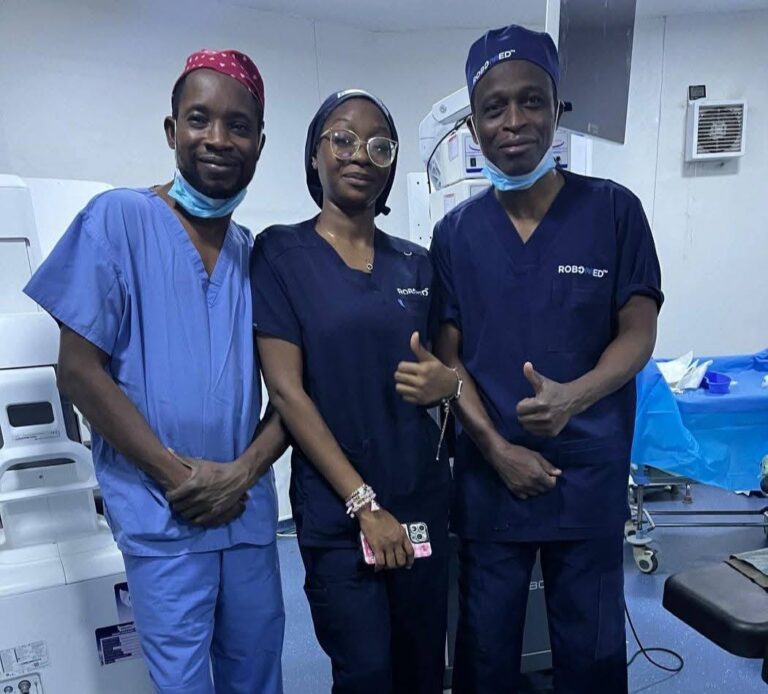
The pioneering procedure was carried out on January 30, 2026, at Nisa Premier Hospital by Dr. Ahmed Abdullahi, a specialist from Numan Local Government Area of Adamawa State. He performed a robotic-assisted laparoscopic myomectomy using the state-of-the-art Microport Toumai MT-1000 robotic surgical system.
The patient, a 22-year-old woman diagnosed with uterine fibroids through ultrasound imaging, chose the robotic procedure as a minimally invasive alternative to traditional open surgery. The operation was completed successfully with minimal blood loss and no need for transfusion. Remarkably, she was discharged just hours after surgery, experiencing only mild discomfort and demonstrating rapid recovery.
A Shift from Conventional Surgery
Unlike conventional fibroid surgery, which typically involves larger incisions and longer hospital stays, the robotic-assisted approach relies on tiny, highly precise cuts. This significantly reduces tissue trauma, postoperative pain, and recovery time.
Speaking after the operation, Dr. Abdullahi explained that robotic-assisted systems provide enhanced three-dimensional visualisation, superior instrument dexterity, and improved precision. These features enable surgeons to perform complex procedures with greater accuracy, reduced surgical error, and faster healing outcomes.
He was supported during the surgery by Dr. David Ejenobo, a consultant gynaecologist at Nisa Premier Hospital, whose collaboration contributed to the seamless execution of the procedure.
Strengthening Nigeria’s Medical Capacity
The milestone was made possible through a strategic partnership between Nisa Premier Hospital and RoboMed Global. The Chief Executive Officer of RoboMed Global, Dr. Obi Ekwenna, described the development as a transformative moment for women’s healthcare in West Africa.
He reaffirmed the organisation’s commitment to expanding robotic surgical infrastructure across Nigeria and strengthening local expertise through specialised training and technology transfer initiatives.
Medical experts note that robotic surgery is particularly effective in managing conditions such as fibroids, endometriosis, and certain tumours. Compared to traditional open surgery, patients often benefit from reduced pain, shorter hospital stays, minimal scarring, and quicker return to daily activities.
A Proud Moment for Adamawa and Nigeria
Beyond its clinical success, the operation signals Nigeria’s growing capacity to deliver world-class healthcare services locally, potentially reducing the need for costly foreign medical travel.
For Adamawa State, the achievement stands as a source of pride, highlighting the emergence of homegrown medical professionals who are blending global innovation with local expertise.
As robotic surgery continues to gain traction across Nigeria and the wider West African region, this historic procedure marks the beginning of a new era in precision-driven, technology-powered healthcare delivery.