As bills rise across the world, campaigners call out the fossil fuel and weapons firms raking in mega profits.
As the death toll in Iran moves above 3,500 and energy bills rise for households in United Kingdom, fossil fuel and weapons companies have seen their profits rise dramatically since the war by the US and Israel began two months ago.
The standoff in the Strait of Hormuz has left 1,600 vessels and 20,000 seafarers stranded in the Gulf amid tensions between the United States and Iran, as Brent crude rises above $107 a barrel.
While hitting the pockets of millions in Europe, Asia and worldwide, the war has created big winners. On Monday, a report from the Stockholm International Peace Research Institute (Sipri) found that global military expenditure had increased to $2.887 trillion in 2025, the 11th year of consecutive rises.
Recent analysis conducted by climate charity Global Witness for the Guardian found that major oil and gas companies made over $30 million an hour in the first month of the war on Iran.
This comes as United Kingdom household energy bills are projected to rise by as much as £300 ($406) a year from July due to shortages caused by the closure of the Strait of Hormuz, with recent polling suggesting 44 percent of the public would be unable to afford these increases, as well as triggering global food insecurity.
Meanwhile, the CEOs of Britain’s biggest energy companies have seen their personal fortunes surge by millions following the crisis.
Linda Cook, chief executive of oil and gas company Harbour Energy, saw her shareholdings in the company rise by more than £4m to a total of £26m in the month after US-Israeli strikes began in late February.
In the same period, the value of Shell CEO Wael Sawan’s shares in the company increased by nearly £1.8m, to reach £13.2m, according to the End Fuel Poverty coalition. Centrica boss Chris O’Shea saw the value of his shares rise by over £300,000 and BP’s deputy chief executive Carol Howle’s stake grew by over £500,000.
Globally, Chevron chief executive Michael Wirth saw more than £44m added to the value of his stake in the company, and Equinor, the Norwegian firm that supplies much of the UK’s gas, saw its shares rise by over 45 percent.
Because oil and gas markets are globally priced, “disruptions in supply anywhere in the system raises prices everywhere,” Jagannadha Pawan Tamvada, a professor of business economics at Kingston University, told Middle East Eye. Since demand is less flexible, this translates into higher prices for consumers and higher revenues for producers.
 Smoke rises following an explosion, amid the U.S.-Israeli conflict with Iran, in Tehran, Iran, March 7, 2026. Majid Asgaripour/WANA (West Asia News Agency).
Profits from arms
A similar trend is true for defence companies.
As the United States spends on average $1.8bn a day paying for the war on Iran, Lockheed Martin – the largest Pentagon contractor, which often takes in more taxpayer money than the entire State Department – saw its stock price rise by nearly 40 percent at the beginning of March since the start of 2026.
“From an incentive perspective, these outcomes are predictable consequences of systems in which uncertainty and risk are directly monetised,” said Tamvada, with “expectations of future instability” leading to a rise in defence stocks.
The cost of such instability is not felt by these corporations but rather experienced as a benefit. “In effect, risk is socialised downward to consumers while upside is concentrated upwards,” Tamvada said.
“It is not that a shortage increases the companies’ costs. Instead they charge more because they can. They pocket the difference,” explained Ruth London, a founding member of campaign group Fuel Poverty Action (FPA).
“The fossil fuel industry kills through poverty, through oil wars, through pollution and through climate change. It has made a killing from the war against Iran. And yet it is subsidised.”
While recent figures suggest almost 10,000 deaths are linked to cold-related health conditions due to fuel poverty every year in the United Kingdom, oil and gas bosses rake in millions, worsening inequality that is already “exceptionally high, and rising”, according to FPA.
Fossil fuel tax evasion
“Oil and gas price shocks are like Christmas for fossil fuel companies: they can sit back and watch as their profits multiply,” Philip Evans, senior climate campaigner at Greenpeace UK told DailyMail.
“We need a bold government response to tax the profiteering of oil companies in the current crisis,” Evans added.
One way that governments can challenge these incentives is increased taxation on the companies raking in huge pay-days from global instability.
Tax Justice UK, which campaigns for higher taxes on the super rich, sent a letter to the British government with signatories from 40 leading civil society organisations, calling on the chancellor to tackle corporate profiteering from the Iran war and levy adequate windfall taxes to avoid the economic burden falling on consumers.
“During these times of global crises, certain companies make record profits amidst human suffering in Iran and ordinary people in this country end up footing the bill,” Tax Justice UK’s deputy director, Caitlin Boswell, told MEE.
“We have a tax system that is built on protecting wealth,” she said, due to lobbying from companies that allows them to avoid paying their fair share of tax and continue receiving government handouts subsidising fossil fuel energy.
While the UK government was able to introduce a windfall tax that raised £6.8bn in 2022-2023 on energy companies reaping profits from Russia’s military operation in Ukraine, negative framing in the press highlighted the industry’s influence over the media.
YouGov polling shows the cost of living crisis is the number one concern among voters. But, beyond the windfall tax on the oil and gas industry, the Labour Party government remains reluctant to sufficiently redistrubute the wealth of companies profiting from the energy spike, which, according to Boswell, “just goes to show the sheer power of these vested interest groups and these industries that have… too much political capture.”
 Houthi activists burn U.S. and Israeli flags during a demonstration in solidarity with Iran and Lebanon, amid the U.S.-Israeli conflict with Iran, in Sanaa, Yemen March 6, 2026.
Renewable Energy
Speaking to MEE, Patrick Galey, head of investigations at Global Witness, said that “the fossil fuel industry is the richest and most powerful to ever exist, and therefore also the most devious”.
Galey said the industry had gone from “decades of denial” relating to climate change, to a “repeated, sustained, designed pattern of obfuscating, of delaying” action to tackle it when the science became undeniable.
The war on Iran has prompted the second energy shock to consumers in the last five years – the first being the impact of Russia’s military operation in Ukraine – with forecasts suggesting the fallout from this disruption will be far sharper.
The lesson that needs to be learnt, Galey said, is that we need to pivot away from oil and gas and invest in renewables – not just for the climate, but for national security too.
“Energy independence engenders genuine geopolitical freedom and independence because you are not having to constantly tiptoe around the autocrats that you want to buy fossil fuels from,” he said, pointing to Spain as an example of where the government has been able to stand up to the Trump administration because it is not reliant on U.S. energy.
Not doing so is a result of “government choice”, Galey said, referencing analysis showing that Labour ministers met fossil fuel lobbyists more than 500 times in their first year in power, and that the party’s new intake of MPs from the last general election took more than £45,000 in donations from oil and gas.
‘Open Plan Office’
Fossil fuels and defence are among the most heavily subsidised industries in the UK, with an estimated £17.5bn given out in oil and gas subsidies per year, while £1bn in government science subsidies went to BAE Systems, Britain’s largest arms company.
According to Andrew Feinstein, a former African National Congress MP in South Africa and founding director of Shadow World Investigations, this is effectively a form of “corporate welfarism”, and a way of “privatising public money” through state subsidies and contracts.
The arms trade is a “very fertile sector for corruption”, Feinstein told AfrikTimes, accounting for an estimated 40 percent of global trade corruption, despite representing only 0.5 percent of global trade.
He pointed to the brazen insider trading occurring in the US, including on the platform Polymarket, where US President Donald Trump’s son, Donald Trump Jr, is an investor and sits on the advisory board.
Trades placed more than $500m in oil futures bets minutes before Trump announced “very good and productive conversations” with Iran, according to the Financial Times, suggesting insider knowledge. “I have never seen war and conflict manipulated so nakedly for short-term profiteering… that is an element which is quite unique to the assault on Iran,” Feinstein said.
“Wars are being partly fought to enable insiders to play the stock market and to profiteer in the short term on national security announcements,” he said. There is “little attempt to hide it”.
The arms industry also has the “added advantage of secrecy”, Feinstein said. In 2010, BAE Systems was fined $400m by the US for corrupt deals.
 Demonstrators hold images of Iran’s late Supreme Leader Ayatollah Ali Khamenei, after he was killed in Israeli and U.S. strikes on Saturday, during an anti-Israeli and U.S. rally after Friday prayer, amid the U.S.-Israeli conflict with Iran, in Tehran, Iran, March 6, 2026. Majid Asgaripour/WANA (West Asia News Agency).
Nevertheless, these companies are treated as an “arm of the state”, Feinstein explained, and their CEOs have an “incredibly high security clearance” not afforded to other industries, allowing them access to sensitive information and influence over government policy.
While defence companies are privately owned, they receive “massive subsidies” with taxpayer money through the state defence budget, while profits are “appropriated privately”, Anna Stavrianakis, professor of International Relations at the University of Sussex, told AfrikTimes.
Campaign Against Arms Trade has described the relationship between private defence companies and government as not just a “revolving door”, but an “open plan office”, illustrating the close relationship and influence the industry has over government policy.
The Israeli weapons manufacturer Elbit Systems, for example, has already carried out “direct interference… with our democratic process”, Stavrianakis said, by meeting with the Home Office amid the crackdown on direct action group Palestine Action, which has targeted Elbit.
“There is a shared set of assumptions between industry and government that protest needs to be contained and that direct action needs to be repressed,” Stavrianakis said.
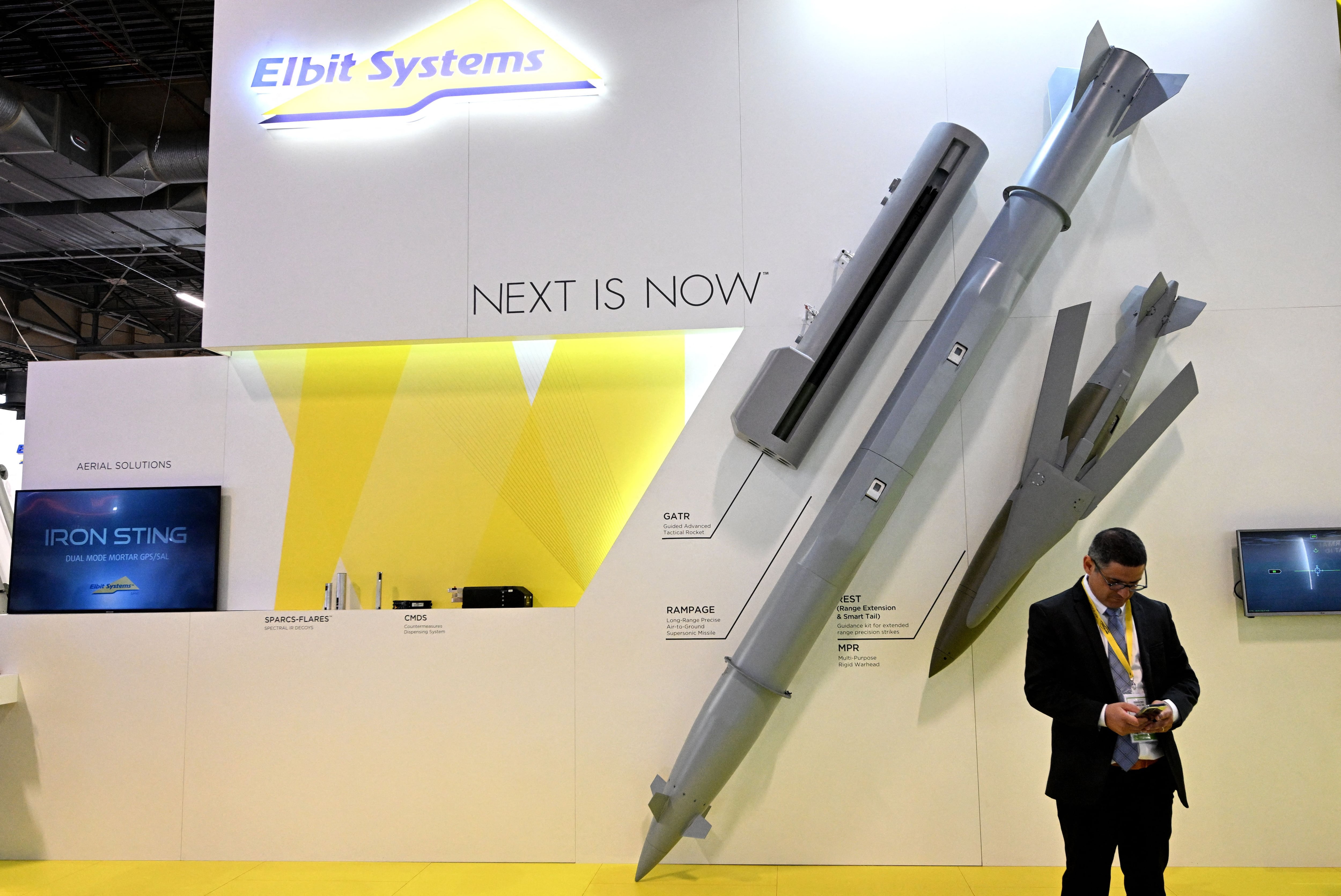 A staff member of Israeli company Elbit Systems looks at his phone at the Eurosatory trade fair in Paris on June 13, 2022. (Emmanuel Dunand/AFP via Getty Images)



 By
By