

 By
By Amnesty International has concluded that the paramilitary Rapid Support Forces (RSF) in Sudan have committed crimes against humanity and ethnic cleansing in North Darfur state’s el-Fasher, a report released on Wednesday showed.
The findings support mounting evidence from the past year that the RSF carried out widespread atrocities in its 18-month siege of el-Fasher, based on an analysis of images and videos by Middle East Eye.
Agnes Callamard, Amnesty International’s secretary general, called the findings of the new report “a stain on the conscience of humanity.”
“Children were not collateral damage of this violence – often, they were deliberately targeted and have suffered immensely. They have been killed, injured, raped, abducted, and forcibly recruited on a massive scale,” she said in a statement.
“A nationwide ceasefire is immediately needed,” the statement added, and also called for an independent international force to be deployed to Sudan.
Amnesty found that non-Arab communities, particularly the Zaghawa ethnic group, were deliberately targeted, and that investigators documented the use of ethnic slurs and references to slavery – such as “falangay” – during those attacks.
The RSF also burned villages after residents fled in order to prevent their return, actions Amnesty said are consistent with ethnic cleansing.
The organisation relied on interviews with 247 people, the vast majority of whom witnessed or experienced violent abuses in North Darfur state, which borders Libya and Chad.
Among them were nine men who were held in Mina al-Bari detention centre, on the eastern outskirts of el-Fasher, for periods of up to five months between mid-2024 and early 2026, Amnesty said.
They said they were detained in shipping containers, which were kept closed most of the time, and so the stifling heat and minimal air circulation made it difficult to breathe.
“My body was [drying out] completely, other people as well as myself lost consciousness,” one man recounted.
“[The RSF] thought we had died, so they just threw us out of the container. After a while, they realized we were still alive. They tortured us again and took us [back] inside the container.”
International community
Amnesty’s report identifies three RSF leaders it accused of “serious violations of international law.”
They include RSF commander Al-Fateh Abdullah Idris, known by his nom de guerre Abu Lulu, who has been seen on video executing captives wearing civilian clothing.
Senior RSF commanders identified at the Mina al-Bari detention facility include Major General Gedo Hamdan Ahmed Mohamed, known by his nom de guerre Abu Shouk, and Lieutenant Colonel Abbas Khater Bakhit, both of whom are reported to have tortured captives.
“The international community must move beyond statements of concern,” Callamard said.
She blamed humanitarian funding cuts by high-income countries – a move spurred by the return of the Trump administration to power in the US last year – and the lack of support for accountability mechanisms such as the United Nations and the International Criminal Court (ICC), both of which have been undermined and threatened, with US sanctions targeting officials from the international bodies.
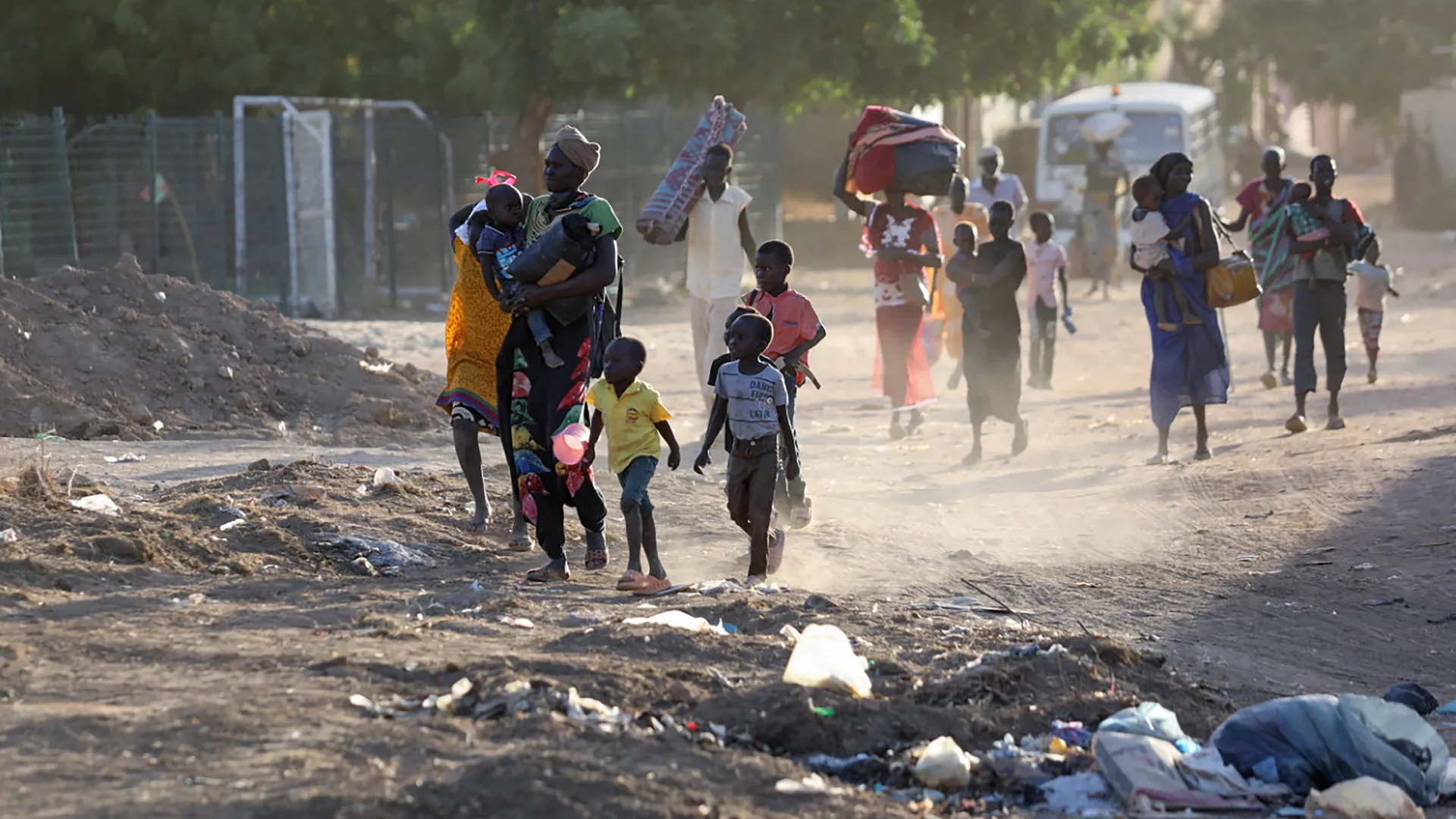
Sudan remains the site of the largest continuous humanitarian and displacement crisis in the world, the non-profit Refugees International said last month.
During the siege of el-Fasher from May 2024 until October 2025, famine also spread quickly, forcing families to consume ambaz, a byproduct of peanut oil production normally used as animal feed, the report said.
UAE and US role
The Janjaweed, which carried out genocide in Darfur more than two decades ago, is where the RSF finds its roots.
In March 2025, based on intelligence shared by the former Biden administration, Maryland Democratic Senator Chris Van Hollen introduced a bill to stem Washington’s inadvertent pipeline to the RSF.
The bill was blocked by Republicans about six months later, shortly after the RSF advanced into el-Fasher and seized a Sudanese military outpost.
Since the civil war began in April 2023, Washington, under two successive administrations, has continued to authorize weapons sales to its ally, the United Arab Emirates.
The UAE hosts Al Dhafra Air Base and has developed close ties with the Trump family.
Although Emirati officials have denied the allegations, extensive reporting by media organizations including Al Jazeera and Middle East Eye, citing satellite imagery, flight and ship tracking data, video evidence, weapons serial numbers, and multiple regional sources, has alleged that the UAE supplied weapons to the RSF throughout the conflict.
Late last year, Sudan’s ambassador to the United States, Mohamed Abdalla Idris, cited a bipartisan effort led by Idaho Republican Senator Jim Risch in calling on the Trump administration to designate the RSF as a terrorist organization. He said such a designation would pave the way for sanctions and strengthen international efforts to protect civilians.
“Boko Haram was designated. Al-Qaeda was designated. IS was designated… why not the Janjaweed? What the Janjaweed are doing is far even worse than what some of those organisations have done,” he said.
Sexual Violence
Amnesty International’s findings follow a United Nations report released last month that said the RSF was responsible for the majority of conflict-related sexual crimes committed during Sudan’s three-year war.
The UN trend analysis on conflict-related sexual violence since fighting erupted between the RSF and the Sudanese Armed Forces (SAF) in April 2023 found that rape, gang rape, and sexual slavery have been used systematically as weapons of war. The report warned that continued impunity could entrench cycles of violence for years to come.
According to the report, about 87 percent of verified incidents were attributed to men wearing RSF uniforms, affiliated fighters, and allied Arab militias. Other documented incidents were attributed to the SAF, affiliated security actors, the Joint Forces, and other armed movements.
Middle East Eye has also reported extensively on the RSF’s primary financial and logistical backer, the United Arab Emirates.
Despite pressure on Abu Dhabi stemming from the U.S.-Israeli war with Iran and an Egyptian bombing campaign targeting RSF weapons convoys originating in Libya, the UAE and Khalifa Haftar’s Libyan Arab Armed Forces (LAAF) continue to support the Sudanese paramilitary group, according to the report.
A joint investigation by Lighthouse Reports, Sudan War Monitor, and Evident, published on Monday, said RSF fighters are being trained to use weapons supplied by the UAE at military camps across Libya.
According to defectors from the RSF and sources within the LAAF cited in the investigation, the five camps identified by investigators have also been used to provide the Sudanese paramilitary with logistical support, including fuel and pickup trucks.
Also on Monday, a coalition of human rights organizations requested that the International Criminal Court investigate the role of senior officials from the UAE and Sudan’s neighboring countries over allegations that they aided and abetted atrocity crimes in Darfur.
The submission was filed by the Raoul Wallenberg Centre for Human Rights together with a broad coalition of legal, investigative, and civil society organizations.