


 By
By - From Akure to Lagos, officers have been killed or hurt while trying to stop heavy vehicles, as speed limits go unenforced and the law on who may stop motorists stays unsettled.
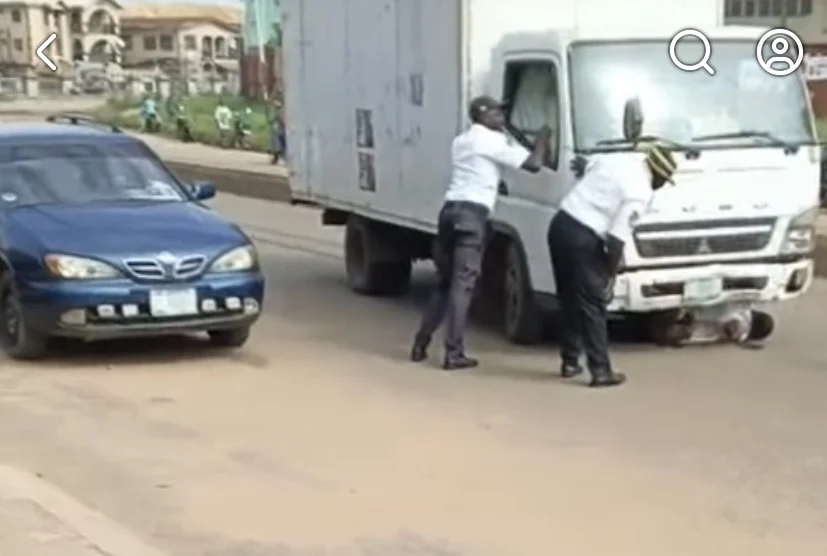
A Vehicle Inspection Officer (VIO) was reportedly crushed to death by a truck in Akure, the Ondo State capital, on Friday. It is the latest in a string of cases in which Nigerian road enforcement officers have died or been injured while trying to stop heavy vehicles.
The incident happened along Hospital Road, opposite Mega Primary School, according to a video posted by Akure-based radio station Crest FM, which AfrikTimes has reviewed. Eyewitnesses reportedly said the officer tried to intercept the truck, which was already in the fast lane, but could not stop it in time. Residents are heard shouting as the officer lies trapped, and some of his colleagues are seen in panic. His identity and the reason for the stop have not been confirmed.
Not the first scare in Akure
An earlier crash in the city also involved a VIO operation. A tipper truck hit vehicles near the VIO office on Pa Reuben Fasoranti Road while inspection checks were underway, and two brothers on a motorcycle died, according to Arise News. Police said the truck was not registered. Residents blamed traffic build-up around the office for exposing road users to danger.
The Ondo FRSC commander told Channels Television the crash was avoidable and was caused by the driver losing control.
Officers hit across the country
The pattern is not limited to Ondo. In Ekiti, a VIO officer who waved down a commercial bus was hit and seriously injured, and he told reporters the driver sped up on seeing his team, according to News Central TV. A manhunt followed.
In December 2021, on the Sagamu-Ijebu Ode Road in Ogun, a trailer pinned an FRSC officer against a patrol vehicle at a checkpoint. The driver did not stop but was chased down by motorists and riders and handed to police, the sector commander told the Peoples Gazette.
FRSC said five of its operatives died in September 2025 after being knocked down by motorists in Ekiti, Ogun, Taraba, Jos and Obollo Afor, Vanguard reported. The Corps Marshal ordered the drivers prosecuted.
Prosecution can work, and this is seen in how a Lagos High Court sentenced a truck driver to life imprisonment on 14 January 2026 for killing an FRSC marshal on lawful duty, Leadership reported.
Speed, trucks, and a missed deadline
The wider road record is grim, as FRSC recorded 10,446 crashes and 5,289 deaths in 2025, with total crashes up 9.2% on 2024, according to the News Agency of Nigeria. Speed violations accounted for 41% of identified causes of crashes during the December 2025 festive operation, NAN reported. According to Blueprint, some analysts say deaths are heavily underreported.
Speed limiters for trucks were meant to be compulsory from 2016, but Daily Trust says full implementation is still missing. In April 2025, an FRSC commander in Ogun again promised to intensify enforcement after three truck crashes killed 25 people in one day, the Peoples Gazette reported.
Who may stop a vehicle?
On 4 December 2025 the Court of Appeal in Abuja upheld a Federal High Court judgment that the VIO has no statutory power to stop, impound or fine motorists. ICIR reported that the ruling did not affect the FRSC. Additionally, BusinessDay reported that the VIO was heading to the Supreme Court.
That case concerned the Federal Capital Territory directorate. Whether it binds state VIOs such as Ondo’s is an open legal question. Humangle documented Abuja motorists describing extortion by VIO officers, but those accounts concern the capital and not Ondo.
Who must answer
Drivers who speed at officers or flee the scene have no defence, and courts have shown they can be jailed. In the same vein, owners who put unregistered or unfit trucks on the road share the blame, as the police statement about the Akure tipper suggests. Agencies that flag down vehicles in live lanes, or run checks that pile traffic onto a road, are responsible for the risk that creates, whatever the legal answer on their powers. Regulators who set a speed-limiter deadline in 2016 and still promise to “intensify” it in 2025 have failed the people who share those roads.
For the Hospital Road death, that judgment must wait. The officer’s reason for stopping the truck, the lane, the signage and the driver’s conduct are all unconfirmed.
What must change
These are AfrikTimes proposals and not reported findings.
- Check vehicles only in marked bays off the live lane, with cones, advance signs and a rule that no officer steps into moving traffic.
- Use number plate cameras and FRSC verification tools to flag defaults without a physical stop.
- Enforce speed limiters at depots and loading points, where tipper journeys begin.
- Trace the owner whenever an unregistered heavy vehicle kills, and prosecute whoever let it out.
- Prosecute every case and publish outcomes, so the Lagos life sentence becomes the norm.
- Settle the law on who may stop vehicles, through the Supreme Court or the National Assembly.
- Insure and compensate officers and their families, and publish a count of officers killed on duty.
The officers who die at these stops are doing a job the country needs, and they are dying faster than the system around them is changing. Until stops move off the live lane, speed limiters are enforced, and every killer driver is prosecuted, the next video from the next junction is only a matter of time.