

 By
This is a working report on sections 1 to 20 of the law. Section 21 onward has not yet been reviewed, so the observations below are provisional and may change as the review continues.
Where the review stands
The Osun State Integrated Transport, Traffic and Park Management System Law, 2026, responds to a period of contested control over the State’s motor parks and of complaints about how money is collected from them. In the sections reviewed so far, it moves authority over government parks from union office to appointed park managers, requires commercial transport operators to enrol on a State register, and provides for electronic collection and a fixed split of single-ticket revenue.
The sections contain protections for operators. They bar forced union membership and the seizure of keys or documents (section 7(10)), state that an appointment gives no one a proprietary interest in a park (7(6)), prohibit compelled cash payments and tax roadblocks (20(2) and (3)), and limit what the Task Force may do (10(5) and 10(8)). They also leave several matters open. The revenue split in section 20(7) rests on bodies the sections do not define, and the structure of the Task Force, the fees and many deadlines are left to regulations. The law’s constitutional footing is disputed and a court case is pending. These points are set out below and will be read again once the rest of the law has been reviewed.
Background: who runs Osun’s parks has been contested since 2023
Control of Osun’s motor parks, and the right to collect money from them, has been contested since at least January 2023. On 9 January 2023, Governor Ademola Adeleke proscribed the National Union of Road Transport Workers (NURTW) and other transport unions and set up an 11-member committee, with the Osun Internal Revenue Service (OSIRS) and two ministries represented, to run a “one-ticketing system.” The stated aims included ending violence between rival union groups, as reported by Ripples Nigeria.
On 23 April 2025 the State adopted a unified ticketing system with a flat daily fee of ₦100 for okada riders and ₦200 for tricycle operators and no other fees (Osun State Government). Sahara Reporters later wrote that the NURTW regained control of parks “following legal and political developments.” The sources reviewed do not say how the 2023 arrangement ended.
The most recent phase began in July 2026. On 20 July, gunshots disrupted parks in Osogbo and, as reported by Sahara Reporters, the Governor threatened to withdraw the NURTW’s management of parks. On 23 July, after a Security Council meeting, the State suspended NURTW activities in the parks and suspended all levy collection there. It ordered the arrest of people posing as union officials and set up a Rapid Response Squad. On 24 July, the union’s national leadership inaugurated a seven-man caretaker committee for Osun parks led by Kazeem Oyewale, known as “Asiri Eniba”, and said no governor can suspend the union.
On 13 September, Olalekan Oyeyemi, who is known as “Emir Ajagungbade”, was shot dead at Mayfair park in Ile-Ife. The next day, the Governor banned NURTW activities statewide, ordered rival groups out of parks and garages, and promised a Park Management System by executive order. The police have not publicly given a motive or named suspects in the Ile-Ife killing.
The House of Assembly passed the bill on 23 September after its third reading. The sponsor, Works and Transport Committee chairman Abiola Ibrahim, cited revenue leakages and park disputes. In late September, the All Progressives Congress (APC) called the bill unconstitutional, citing section 7(1) and the Fourth Schedule of the Constitution. The Assembly answered that listing motor parks as a Local Government function does not remove State competence, and told the APC to go to court (Premium Times). Governor Adeleke signed the law at Government House, Osogbo. Premium Times dates it to 5 October, while the police commissioner said at a security briefing on 22 October that it was signed on 15 October.
In October, 8 NURTW state executives filed suit HRE/28/2026 at the Ikire High Court and asked security agencies to maintain the status quo. No hearing date or interim order has been reported yet. On 21 October, officials told operators they have 60 days from assent to register and that the daily levy will be tied to verified operation. On 22 and 23 October, the State briefed security agencies on enforcement, and no enforcement start date has been reported.
The problems on the record fall into four groups. The first is control of parks, where the contest between factions has involved shootings in July, August and September 2026. The second is cost to operators. The Assembly’s and Government’s statements cite multiple ticketing, illegal levies, unclear accountability for park revenue, and leakage from the State’s internally generated revenue, but the sources reviewed provide no figures on what operators paid or what was lost. The third is that earlier remedies, namely the 2023 proscription and committee, the 2025 flat-fee ticketing and the September 2026 executive order, were executive acts and not a statute. The fourth is the legal footing of the new law, which the Assembly and the APC read in opposite ways.
Sections 1 to 6: a State agency with stated limits
Sections 1 to 6 create a State agency and a coordinating committee, and section 2 states the limits of the law’s reach at the outset. The law applies to commercial transport, traffic, motor parks, garages, terminals, loading points and transport infrastructure only to the extent the subject falls within State or Local Government competence. The State may not appropriate, retain or beneficially collect a motor park levy vested in a Local Government (2(2)), and it may not regulate federal trunk roads, shipping, aviation or inter-State rail except as federal law or agreement allows (2(3)). Where a provision can be read in two ways, the reading that fits the Constitution and federal law prevails (2(4)). These are the areas where State, Local Government and federal competence meet.
Section 3 makes the Agency a body corporate that works under the policy supervision of the Ministry of Transport and the “revenue administration requirements” of OSIRS or another lawful revenue authority. The design separates the regulator, which enrols and verifies, from the revenue authority, which assesses and receives money.
Section 4 lists nine objectives. Three speak directly to operators: ending multiple taxation, roadside cash collection and unauthorized levies (4(1)(d)); ensuring that a day on which an operator did not work is not automatically a taxable day (4(1)(e)); and stopping violence, thuggery and the use of parks for crime (4(1)(i)).
Section 5 gives the Agency its functions. It keeps the State commercial transport register and runs compulsory enrolment. It operates automatic number plate recognition cameras and other enforcement technology, keeps records of “verified commercial activity” to support revenue assessment, and prevents illegal parks and loading points. Under 5(2) it can offer technology or management services to Local Government facilities only “where lawfully agreed”. Under 5(12) and (13) it reviews existing park management arrangements during a transitional period, and an existing manager continues only if documented by appointment, licence, concession or contract.
Section 6 creates the State Transport and Traffic Management Committee, which coordinates policy, standards and inter-agency work. The Governor appoints the Chairman, and the Permanent Secretary of the Ministry of Transport is Secretary. Other seats go to OSIRS, the Ministry of Justice, the Accountant-General’s office, security agencies including Amotekun, two directors of the Ministry of Transport, two park managers (one each for the motor and cycle wings), two transport professionals, one of whom must be a woman, and one Local Government representative nominated by the Association of Local Governments of Nigeria (ALGON). The Governor can add anyone else. Most seats therefore go to State officials or appointees. Unions and passengers are not named among the members.
Sections 7 to 10: appointed park managers, no union claim to parks, and a Task Force
Sections 7 to 10 replace union control of government parks with managers appointed by government, and back them with a multi-agency Task Force.
Section 7 allows leadership offices at Unit, Branch, Zone, Local Government and State levels. The appointing authority is the State Government, the Ministry of Transport, the Ministry of Local Government or a Local Government Administration, depending on whose facility or jurisdiction is involved (7(3)). The State sets uniform qualifications, a code of conduct, an identification system and a reporting structure, without taking any revenue or park function reserved to Local Governments (7(4)). Every appointment must be in a written or secure electronic instrument stating the office, jurisdiction, start date, tenure, appointing authority and conditions (7(5)). An appointment gives no union, association, individual or appointee a proprietary interest in a park or any right to collect public revenue unless expressly and lawfully authorized (7(6)). The Ministry of Transport keeps a central digital register of all valid appointments, including those notified by the Local Government side, to verify them and prevent impersonation (7(7)).
On unions, sections 7(8) to (10) do not ban them. The law says union membership, office, “historical presence” or an internal constitution does not by itself give authority over a government-owned or government-designated park, terminal, bay, or route. Those are managed by the government authority, a designated statutory body, or someone it appoints, licenses or contracts. Membership is voluntary and cannot be a condition for operating, getting a permit, entering a park, loading, or receiving a bay or route. Section 7(10) then lists the conduct it prohibits: forcing membership, blocking withdrawal, seizing keys or documents over refusal to join or pay, blocking loading for non-members, threats and assault, unauthorized checkpoints, and taking over a government facility.
Section 8 sets out what managers do and how they are held to account. They run day-to-day operations, supervise electronic tickets, keep the peace with the Task Force, prevent unauthorized or multiple levies, and report daily, weekly and monthly to the Ministry. The term is three years, renewable “for another term” on good performance and integrity. Removal is allowed for misconduct, incapacity, corruption, failure to account for public revenue and similar causes, subject to fair-hearing requirements. Their commissions come from the 30% share retained under section 20(7). Section 9 allows the Agency to cooperate with Local Governments and public agencies with the appropriate authority’s approval, but no delegation can move a constitutionally or statutorily reserved revenue entitlement away from the tier that owns it.
Section 10 creates the Special Task Force. It brings together the Ministry of Transport, the Agency, the Ministry of Local Government, Local Government Administrations, Amotekun, traffic-management and vehicle-inspection authorities and other designated agencies. Federal agencies such as the Police, the Nigeria Security and Civil Defence Corps and the Federal Road Safety Corps may take part only under federal law, consent or agreement, and the law says it does not alter their chain of command. The Task Force can run joint operations, serve enforcement notices, tow or impound where authorized, arrest where legally empowered, and refer or prosecute through the Attorney-General’s counsel. No member may collect cash on a road, at a park or from an offender except through a legally permitted channel, and the Task Force cannot imprison, decide guilt, permanently confiscate property without lawful process, or exercise judicial power (10(5) and (8)). Membership, deployment, identification, uniforms, accountability and operating procedures are left to regulations made by the Governor (10(7)), and body-worn camera evidence is required only “where practicable” (10(6)).
Sections 11 to 19: registration of commercial transport operators
Sections 11 to 19 make operating a commercial vehicle in Osun a registered and permitted activity tied to a digital identity. The point at which the State checks who may operate moves from the park to a State database.
Under sections 11 and 12, no one may engage in commercial transportation, “directly or through another person”, unless the operator and the vehicle, craft or unit are on the State Commercial Transport Register. Enrolment is compulsory for owners and operators and, where regulations prescribe, for drivers, riders, conductors, fleet managers and digital platforms. The register can classify motorcycles, tricycles, taxis, ride-hailing vehicles, buses, coaches, school or staff transport operated for reward, trucks, tankers, haulage, commercial watercraft, State rail services and non-motorized carriers, plus any class regulations add.
Section 13 gives an enrolled operator a Commercial Transport Operator Permit, renewed annually or as regulations prescribe. It is additional to the driving licence, vehicle licence, roadworthiness certificate, route approval, insurance and any federal licence, and it replaces none of them. The sections reviewed set no fee. Officials told operators in October that a daily levy will apply only to days of verified operation (The Sun).
Sections 14 to 16 deal with identity and credentials. Each unit is linked in the register to its registration number, owner, operator, approved class and principal operating area. The Agency may issue a Near Field Communication, radio-frequency identification or QR credential tied to the unit, for identification, verification, “activity evidence” and other lawful functions, and not as a substitute for a number plate. Enrolled persons must notify the System within a prescribed period of changes in ownership, operator, driver, registration number, route, class, contact details or loss of credential.
Section 17 requires digital platforms that facilitate commercial passenger or goods transport to register and to ensure, “to the extent reasonably practicable”, that vehicles and drivers activated on them are enrolled and licensed. Because of that qualifier, liability will depend on what counts as reasonable.
Section 18 makes it an offence to “knowingly operate, permit or facilitate” commercial transport without enrolment, with the penalty set in the First Schedule and with impoundment or suspension possible. Liability reaches owners and facilitators as well as riders, and the word “knowingly” limits it. Section 19 allows regulations to create temporary permits for visiting vehicles, emergencies, special events and inter-State transit, but no exemption can defeat a mandatory federal requirement.
These provisions connect to the objectives in section 4. The register and credential give the State a record of who operates and on which days, which is the evidence base for a levy charged only on verified operating days. Regulations carry much of the detail, including which roles beyond owners and operators must enrol, the permit period, the notification window and the exemptions.
Section 20: collection of revenue and the 70/30 split
Section 20 sets the money rules in eight clauses. Clauses (1) to (6) restrict how revenue is collected, and clauses (7) and (8) deal with the split.
Under 20(1) to (3), lawful revenue is assessed by the competent revenue authority and collected electronically or through an approved channel. No one can be compelled to pay cash to a roadside officer, agent, union or contractor, and no roadblock may be mounted to collect a tax or levy. These provisions answer objective 4(1)(d) directly. The roadblock ban is limited to collection, so it does not prohibit checkpoints for other enforcement. Under 20(4) and (5), Local Government motor park revenue remains the revenue of the competent Local Government Council, and State road taxes and regulatory charges must be distinguished from Local Government park levies in law, accounting and payment references. Section 20(6) prohibits double collection for the same legal incidence.
Section 20(7) provides that, subject to revision by the House of Assembly on the recommendation of the Ministry of Transport, revenue collected under the “single ticketing system” is shared in two parts. Seventy per cent goes to the Treasury Single Account of the State. Thirty per cent is retained for the committee’s operational cost, commissions to Park Managers and sub-Park Managers, and approved incentives to the approved consultant. Section 20(8) requires the committee to ensure automatic electronic splitting and remittance of the Government share daily or in real time, and says the Park Manager’s remuneration is set by the sub-committee.
Two features of the split are worth noting for readers. The first is that 30% is taken before the money reaches the Treasury, and section 20 sets no ceiling on that share. The second is that the split has no Local Government line, although 20(4) says Local Government park revenue stays with Local Governments and 20(5) says State charges must be kept distinct from Local Government park levies. The sections reviewed do not say whether the “single ticketing system” carries State charges, Local Government park levies or both. The terms “the committee”, “the sub-committee”, “the single ticketing system” and “the approved consultant” are used in section 20 without being introduced in the sections reviewed, and the only committee those sections create is the State Transport and Traffic Management Committee in section 6. A unified ticketing arrangement already existed before the law, in the form of the 2025 flat daily fees for okada and tricycle riders, and the law now gives it a statutory revenue formula.
How the provisions respond to the problems on the record
The provisions respond most directly to contested park control and to multiple collection. They respond less completely to the question of where park money goes.
On park control, sections 4(1)(i), 7(6), 7(8) to (10), 8 and 10 end the link between union office and authority over government parks, bar forced membership, key seizure, unauthorized checkpoints and takeovers, and provide a Task Force to enforce. Control now turns on appointment under section 7, so the way managers are chosen carries more weight. The Task Force’s structure is left to regulations, and the NURTW’s suit is pending.
On multiple ticketing, illegal levies and roadside cash, sections 4(1)(d), 8(1)(d), 10(5) and 20(1) to (3) and (6) provide for electronic collection, no compelled cash, no tax roadblocks, no double collection and no cash collection by Task Force members. These provisions work where operators can pay digitally, and the rates and levy amounts are not set in the sections reviewed.
On accountability for park revenue and leakage, sections 3(3), 5(6), 7(7), 8(1)(e) and 20(7) and (8) provide for revenue administration by OSIRS, records of verified activity, a central register of appointments, regular manager reports, and 70% of single-ticket revenue going to the Treasury Single Account with automatic daily splitting. The 30% retained at source has no ceiling in section 20, and the sub-committee and approved consultant are not defined there.
On the earlier reliance on the Governor’s authority, sections 1 to 6 and 9 create a statutory Agency, a Committee, a register of government parks and a legal basis for the ticketing system. The APC and the NURTW dispute the legal footing, and section 2 itself concedes Local Government levies and federal roads.
On the lack of any record of who operates, sections 11 to 19 create a compulsory register, a permit, credentials, platform duties and an offence of unenrolled operation. Many details sit in regulations, and the permit is an extra layer on existing papers.
On the overlap between State and Local Government, sections 2(2) to (4), 4(1)(c), 7(4), 9 and 20(4) and (5) protect Local Government levies, reserved functions and revenue. The 70/30 split has no Local Government line.
Who gains and who bears the cost
Operators gain written protections against roadside cash and forced dues. Sections 20(2), (3) and (6) bar compelled cash, tax roadblocks and double collection, and sections 7(9) and (10) protect against forced union membership and the seizure of keys and papers. They must enrol and hold a permit on top of their existing papers, unenrolled operation is an offence with possible impoundment, and the system relies on access to digital payment.
Vehicle owners and fleet managers have one register entry per unit (section 14). They face liability for “permitting or facilitating” unenrolled operation (section 18) and a duty to keep records current (section 16).
Park managers receive a written, registered appointment and commissions from the 30% share. They have no proprietary interest in the park, serve a three-year term and may be removed for cause, and they report daily, weekly and monthly to the Ministry (section 8).
Unions and associations keep the right of members to use public parks (7(8)(c)), and membership is protected as voluntary (7(9)). Office no longer confers control of government parks (7(8)(a)), and forced dues and obstruction are barred (7(10)). Unions are not named as members of the Committee in section 6, and the sections reviewed do not describe a role for them. The table of contents lists a later section on the relationship with unions, which falls outside this review.
Local Governments receive express protection of park revenue and reserved functions (2(2), 7(4), 9 and 20(4)), one Committee seat through ALGON, and the power to appoint managers in their jurisdiction (7(3)). They are not named in the 70/30 split, and registration and ticketing are State-run.
Ride-hailing platforms are recognised in law (section 17) and must register and check driver and vehicle enrolment as far as reasonably practicable.
For passengers, managers must protect passenger rights (8(1)(f)) and the safety objectives apply (4(1)(b) and (g)). The sections reviewed do not provide for passenger representation on the Committee or a complaints route.
The State Government and OSIRS gain 70% of single-ticket revenue with daily automatic remittance (20(7) and (8)) and a register and records for assessment (5(6)). They give up 30% for running costs, face legal exposure from the constitutional challenge, and rely on regulations for Task Force accountability (10(7)).
Tensions in the design, and questions the text leaves open
The central tension is that the law protects Local Government park revenue in principle while placing park management, registration and ticketing in State hands. The law protects Local Government park levies in sections 2(2), 7(4), 9 and 20(4), yet the State runs the register, the ticketing system and the revenue split, and appoints managers alongside the Local Government side (7(3)). Which tier collects and keeps what at a given park is not settled in the sections reviewed.
A second tension is the cashless rule. Sections 10(5) and 20(2) and (3) bar cash collection and tax roadblocks, and the sections do not say what happens when an operator cannot pay digitally or the system is down. A third is that the law aims to reduce multiple taxation, while adding a permit (section 13) and a State daily levy to existing papers. The total cost to an operator cannot be worked out from sections 1 to 20 because fees and rates are not set there.
A fourth concerns the retained 30% of single-ticket revenue, which stays outside the Treasury Single Account (20(7)). The sub-committee and approved consultant that share in it are not defined. A fifth is the Task Force. It can arrest only “where legally empowered” and impound only “where authorized” (10(4)), so its reach depends on the powers of its member agencies, and its structure, identification, uniforms and accountability are left to the Governor’s regulations (10(7)).
Several questions remain for officials and stakeholders, and the answers will bear on how this part of the law is read. For the Ministry of Transport or the Agency, the open questions are which revenue the “single ticketing system” carries, who the “approved consultant” is and how it was chosen, when the Task Force regulations will issue and who will command it, and what the permit fee and daily levy rate will be. For OSIRS, they are how a non-operating day will be evidenced and how many operators have enrolled since signing. ALGON and Local Government chairmen can say whether councils will keep receiving park revenue and through what mechanism. The NURTW and other associations can state their position on sections 7(8) to (10) and say where their suit stands. Operators and riders can say whether they have the smartphones, bank accounts and network access that cashless collection assumes. The police, Amotekun and the Federal Road Safety Corps can say which arrest, towing and impounding powers they will exercise through the Task Force and under whose orders.
Sources
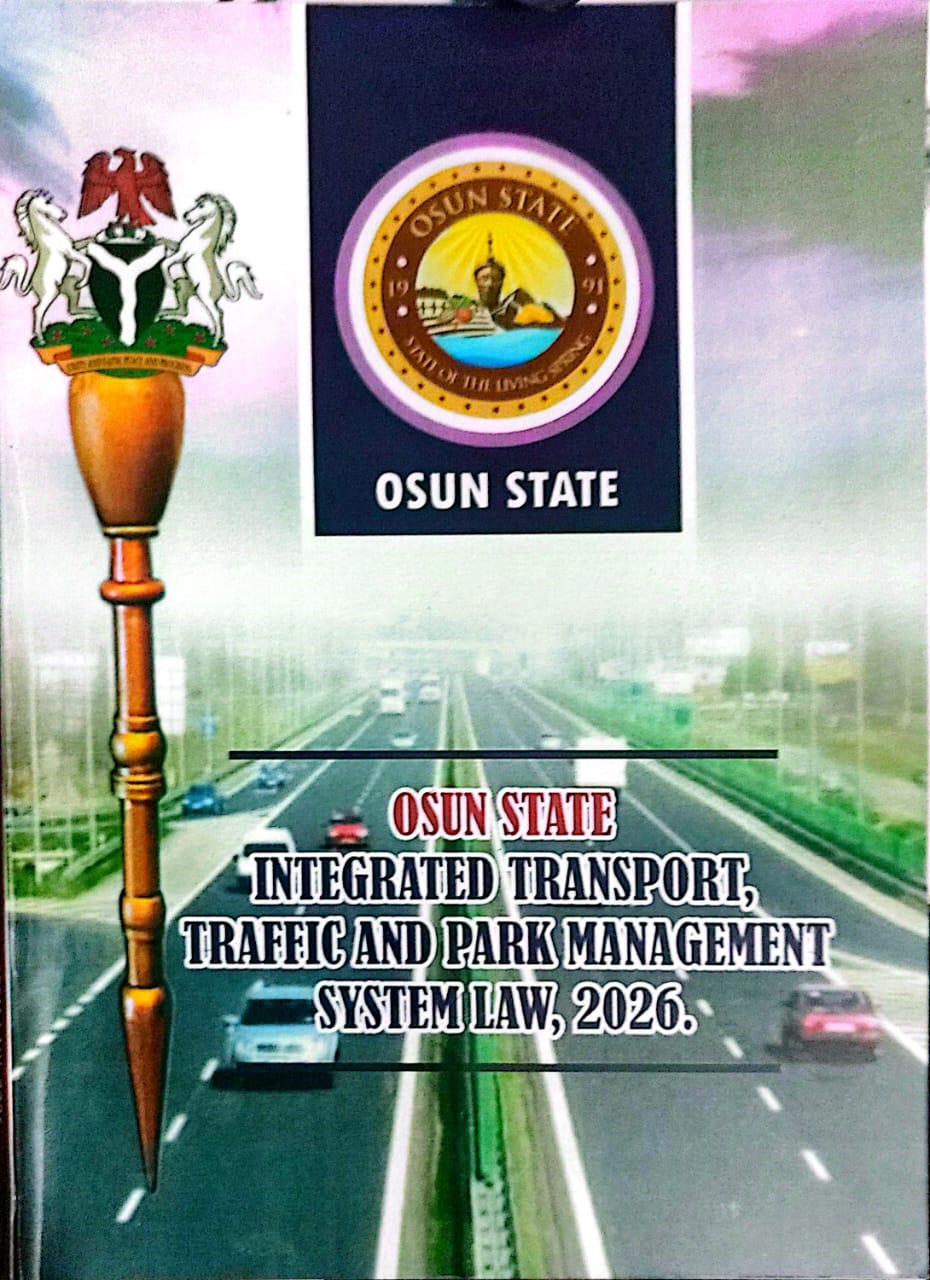
The law text is the printed copy of the Osun State Integrated Transport, Traffic and Park Management System Law, 2026, read and analysed by our reporter up to section 21(2). The pages below were opened and read as of 20 November 2026.
- Adeleke signs Osun park management bill into law amid opposition from APC, Premium Times
- APC, Osun Assembly clash over proposed park management system, Premium Times
- Adeleke bans NURTW activities in Osun after ally shot dead, orders probe, Premium Times
- Adeleke Signs Osun Park Management Bill Into Law Amid Opposition From APC, allAfrica
- Osun Assembly Passes Park Management System Bill, Awaits Governor’s Assent, OsunDefender
- Osun Engages Security Agencies on Implementation of New Transport Law, OsunDefender
- Osun Assembly Passes Bill to End Multiple Ticketing in Motor Parks, Daily Times
- Osun rolls out new transport law to curb multiple taxation, boost safety, The Sun
- Osun Govt. Plans to Improve Transport Sector, Radio Nigeria Ibadan
- NURTW challenges Osun Government’s park management plan in court, TheNigeriaLawyer
- MC Oluomo says governors lack power to suspend NURTW activities; union inaugurates Asiri Eniba-led committee for Osun parks, TheNigeriaLawyer
- Osun Governor Adeleke Suspends NURTW Activities, Orders Arrest Of Union Officials Operating In Motor Parks, Sahara Reporters
- Osun governor Adeleke scrap NURTW leadership of motor parks over violent clashes, Sahara Reporters
- Adeleke proscribes NURTW, other unions, appoints transport committee in Osun, Ripples Nigeria
- Revenue Generation: Osun Adopts Unified Ticketing System for Commercial Motorcycle/Tricycle Riders, Osun State Government