
 By
By Awka, Nigeria — The Nigeria National Grid (NNG) today clarified that residents in Awka, Anambra State, who pay for Band A electricity tariffs are entitled to a minimum of 20 hours of electricity supply per day. The clarification follows complaints from consumers reporting frequent outages despite paying for the highest tariff band.
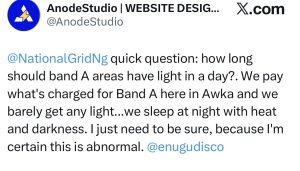
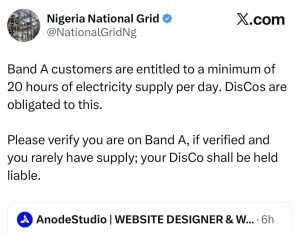
The issue was highlighted on social media when a Twitter user, AnodeStudio, asked the NNG: “How long should Band A areas have light in a day? We pay what’s charged for Band A here in Awka and we barely get any light… we sleep at night with heat and darkness.” In response, the NNG stated, “Band A customers are entitled to a minimum of 20 hours of electricity supply per day. DisCos are obligated to this. Please verify you are on Band A; if verified and you rarely have supply, your DisCo shall be held liable.”
Understanding Band A Tariffs
Band A is the highest customer tariff band under Nigeria’s Service-Based Tariff (SBT) scheme, established by the Nigerian Electricity Regulatory Commission (NERC). Customers in this category are entitled to near-continuous electricity, with the regulatory minimum set at 20 hours per day.
While this entitlement has been part of the regulatory framework for Band A customers, today’s clarification emphasizes the ongoing obligation of distribution companies (DisCos) to comply with the 20-hour standard. Multiple reports, however, indicate that many customers do not consistently receive the full minimum supply due to infrastructure challenges, grid instability, and technical issues.
DisCos’ Responsibility and Consumer Rights
DisCos are legally obligated to provide Band A customers with at least 20 hours of electricity daily. Regulatory authorities, including NERC, can enforce compliance through penalties, compensation, or other sanctions if DisCos fail to meet this standard. Consumers who are verified as Band A but experience frequent outages are advised to report their cases to their DisCo or NERC.
Implications for Awka Residents
The National Grid’s clarification today provides a clear benchmark for service expectations in Awka and other urban centers. It allows consumers to verify their tariff band and take action if supply falls short. This move also underscores the government’s commitment to holding DisCos accountable for underperformance.
Despite the entitlement, the reality for many Band A customers is irregular electricity supply. Reports indicate that outages remain frequent across several regions, reflecting ongoing challenges in Nigeria’s power sector, including aging infrastructure, generation shortfalls, and distribution inefficiencies.
Next Steps for Consumers
Electricity consumers are advised to confirm their tariff band and maintain records of electricity supply to support complaints. Those experiencing shortages despite being in Band A should formally notify their DisCo or regulatory authorities. By doing so, consumers can ensure accountability, encourage improved service, and potentially receive compensation for unmet supply obligations.
Today’s clarification highlights the growing demand for transparency and reliable electricity services in Nigeria. While the regulatory entitlement guarantees a minimum supply for Band A customers, bridging the gap between policy and practice remains a key challenge for the country’s energy sector.