


 By
By The German Agency for International Cooperation (GIZ), in partnership with Action Against Hunger (ACF), has launched a €1 million initiative aimed at supporting about 1.4 million vulnerable people in Borno and Adamawa States through the expansion of Nigeria’s social register and the strengthening of social protection systems.
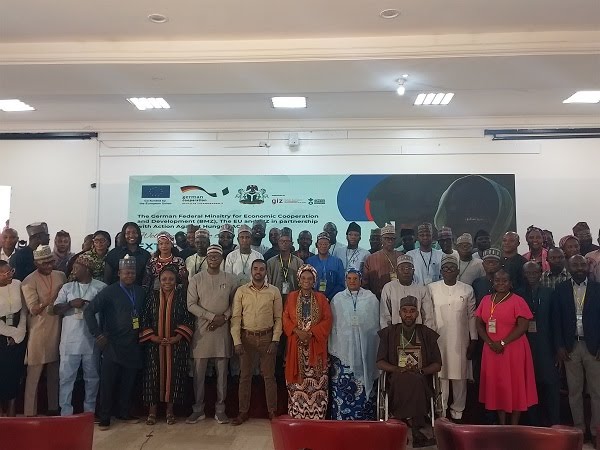
The one-year project, funded by the German Federal Ministry for Economic Cooperation and Development (BMZ) and the European Union (EU), was formally unveiled on Tuesday in Abuja during a kick-off meeting that brought together key stakeholders.
The meeting outlined the project’s objectives, including alignment on methodology, timelines, roles and responsibilities, quality standards, safeguards, risk mitigation, and effective coordination among partners.
Participants at the meeting included representatives of Action Against Hunger, the National Social Safety-nets Coordinating Office (NASSCO), State Operations Coordinating Units (SOCUs), GIZ, and civil society organizations.
Speaking at the event, the Deputy Country Director of Action Against Hunger Nigeria, Andualem Fekadu, said the intervention targets communities affected by prolonged conflict and insecurity, while also incorporating a cash support component to help strengthen household resilience.
“This project is designed to support and strengthen the most vulnerable members of communities in Borno and Adamawa States whose livelihoods have been severely affected by prolonged security challenges,” Fekadu said, adding that implementation will be carried out in close collaboration with state governments.
He disclosed that the €1 million funding has been allocated specifically to the expansion of the Social Protection and Outreach (SOQ) component, with strong monitoring and evaluation frameworks in place to ensure accountability and impact.
“Both GIZ and Action Against Hunger have robust monitoring and evaluation teams that will work closely with state governments and beneficiaries. State-level monitoring and evaluation departments will also be engaged from the beginning to the end of the project,” he explained.
Fekadu acknowledged the scale of humanitarian needs across Nigeria’s North-East, North-West, and North-Central regions but noted that funding constraints currently limit the scope of the project to Borno and Adamawa States. He also highlighted Action Against Hunger’s achievements in Jigawa and Kano States, noting that Jigawa became the first state in Nigeria to develop and implement a social protection policy with dedicated budgetary provisions for vulnerable groups.
Also speaking, the Deputy Commission Manager for Supporting Sustainable Social Protection, Participation and Economic Resilience in Northeast Nigeria, Bolaji Aina, who represented the GIZ Head of Programme, Mrs. Ana Vanambres, said the project aims to expand, update, and improve the social register by approximately 1.4 million people.
She noted that insecurity, displacement, climate shocks, and economic hardship continue to exert immense pressure on vulnerable households and social service institutions.
According to Aina, the project will adopt geographical targeting, Community-Based Targeting (CBT), and proxy means testing to identify and enroll vulnerable households.
She added that the initiative aligns with Nigeria’s broader social protection reform agenda by strengthening state systems and integrating women, internally displaced persons, returnees, and host communities into existing government structures rather than parallel systems.
She emphasized that Community-Based Targeting is key to promoting transparency, accountability, and trust at the community level.
“Success will not only be measured by the number of people registered, but by how well state systems are strengthened and how effectively the data is used to inform social protection interventions and future policy decisions,” Aina said.
On his part, Mohamed Bala, representing the NASSCO National Coordinator, Funmilola Olotu, said efforts are ongoing to link vulnerable households to Nigeria’s national identification system.
“In terms of individuals, we have submitted over 11 million records to the National Identity Management Commission (NIMC), with about 10 million successfully verified. This reform is not only identifying poor and vulnerable households but also providing them with legal identity,” Bala stated.
He added that household geographic coordinates are being captured to improve the accuracy and credibility of the social register.
Bala further explained that while the National Social Safety Nets Project (NASSP) updated 10.2 million households, the Federal Government aims to reach 15 million households nationwide, leaving a gap of about 4.8 million. He noted that partnerships with programmes such as SPIN and SUSI are helping to bridge this gap.
The government is pleased that development partners are supporting this expansion,” he said, adding that future interventions will be fully digitized and implemented at the local government level, with NASSCO providing coordination and oversight.