


 By
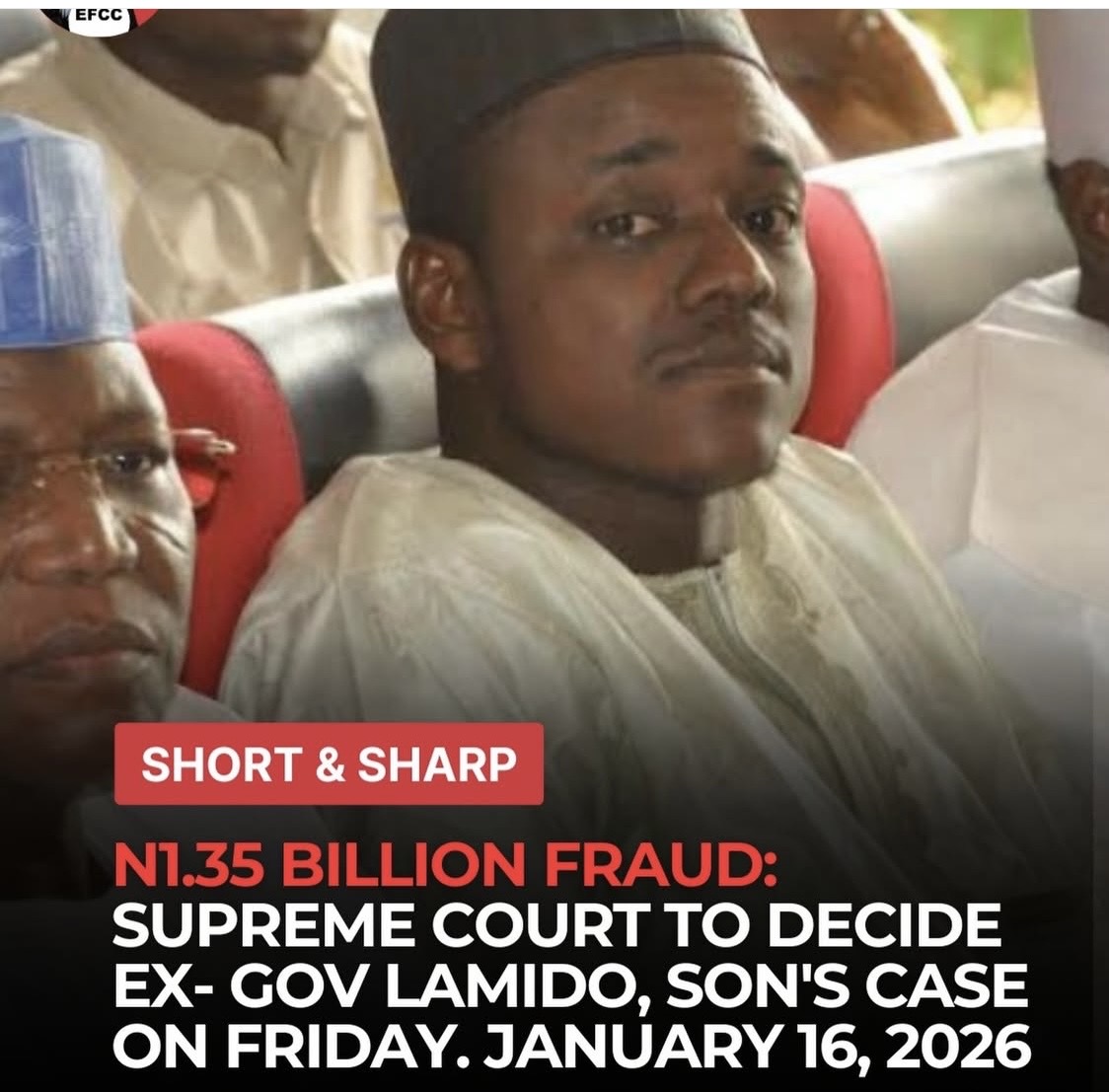
By The Supreme Court of Nigeria will on Friday, January 16, 2026, deliver judgment in the case involving former Jigawa State Governor Sule Lamido and his son, Mustapha Lamido, following an appeal filed by the Economic and Financial Crimes Commission (EFCC).
The case originates from charges filed by the EFCC against Lamido, his son, and other co-defendants over allegations of money laundering and related offences said to have been committed during Lamido’s tenure as governor of Jigawa State between 2007 and 2015.
According to court documents from earlier proceedings, the EFCC alleged that public funds were unlawfully received and moved through private companies linked to the defendants. The prosecution claimed that the funds were proceeds from state contracts and were paid into accounts operated by companies in which Lamido and his son were directors or signatories.
The companies referenced in the charge included Bamaina Holdings Limited and Speeds International Limited. The EFCC alleged that the transactions violated provisions of Nigeria’s money laundering laws in force at the time.
The total sum involved in the amended charges was put at about ₦1.35 billion, spread across multiple counts. The EFCC maintained that the funds were not lawfully received and that their movement through corporate accounts constituted money laundering.
Lamido and his co-defendants consistently denied the allegations. During trial proceedings, the defence argued that the funds were legitimate payments made to companies for contractual and consultancy services and that no offence was committed.
The matter was initially heard at the Federal High Court in Abuja, where the defendants were arraigned on several counts. However, in July 2023, the Court of Appeal, Abuja Division, discharged Lamido and his son after holding that the Federal High Court lacked the territorial jurisdiction to try the case, as the alleged transactions did not occur within its jurisdiction.
The appellate court’s decision effectively terminated the trial at that stage without determining the substance of the allegations.
Dissatisfied with that ruling, the EFCC approached the Supreme Court, challenging the decision of the Court of Appeal. The anti-graft agency is asking the apex court to determine whether the lower court was right to strike out the charges on jurisdictional grounds.
The Supreme Court’s judgment scheduled for Friday will determine the fate of the EFCC’s appeal and whether the case can be revived or finally brought to an end.
As of the time of filing this report, neither Lamido nor his son had made a public statement on the impending judgment. Their legal representatives have also not issued comments.