

 By
By In a functional society, it is expected that the government ensures the provision of basic amenities to guarantee the comfort and productivity of citizens. While food, clothing, and shelter are traditionally regarded as essential needs, electricity has become just as indispensable in a modern economy. From activities ranging food preservation to housing, production, and communication, our daily life is now deeply dependent on power supply.
However, in Ajibode, a community situated near the University of Ibadan in the Akinyele Local Government Area, electricity supply has become more of a luxury than a necessity. For over a decade, residents have grappled with erratic and near non-existent power supply. Sadly, the situation has been forcing businesses, including fuel stations, to completely adopt 24/7 solar power and generators as alternatives.
In 2024, Ajay Banga, President of the World Bank Group, noted that 600 million people in Africa do not have access to power, describing the situation as unacceptable. He believes electricity is a basic human right and the foundation for access to healthcare, education, innovation, manufacturing, and productivity. No doubt, residents of Ajibode represent a portion of this population. When there is no electricity supply, how then does the government hope to address poverty and drive development in society.
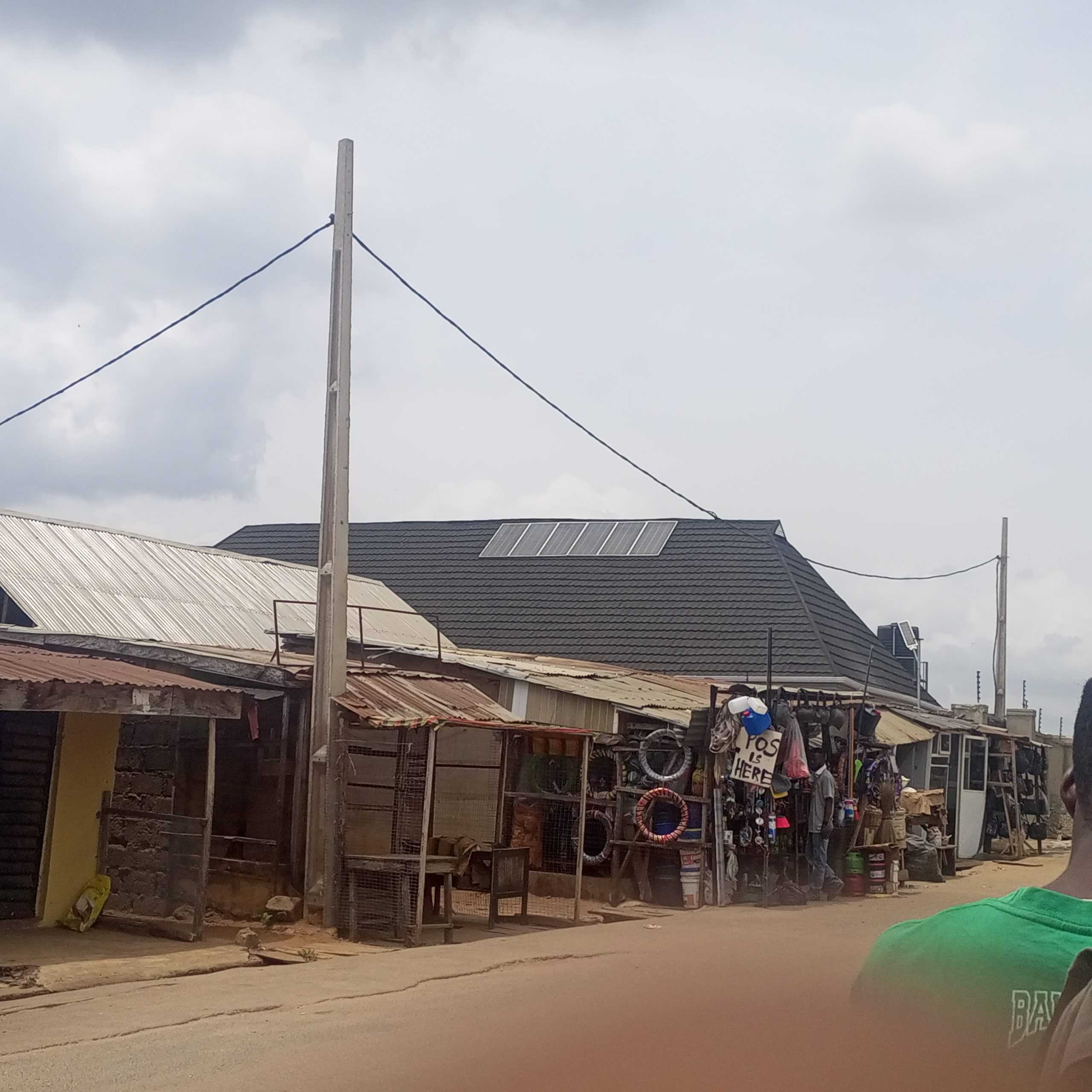
“Ever since I came here four years ago, I have not been using the public power supply, so I don’t even know whether there is light or not. But I know it is not stable. We rely basically on solar,” Mrs. Motunrayo, a small shop owner beside Ajibode Grammar School, told AfrikTimes during a visit to the community. In Ajibode, it is not uncommon to see solar panels mounted on the roofs, while shops also have smaller ones to power bulbs in the evening.
Despite Selling Diesel, Filling Stations Shift to Solar Power
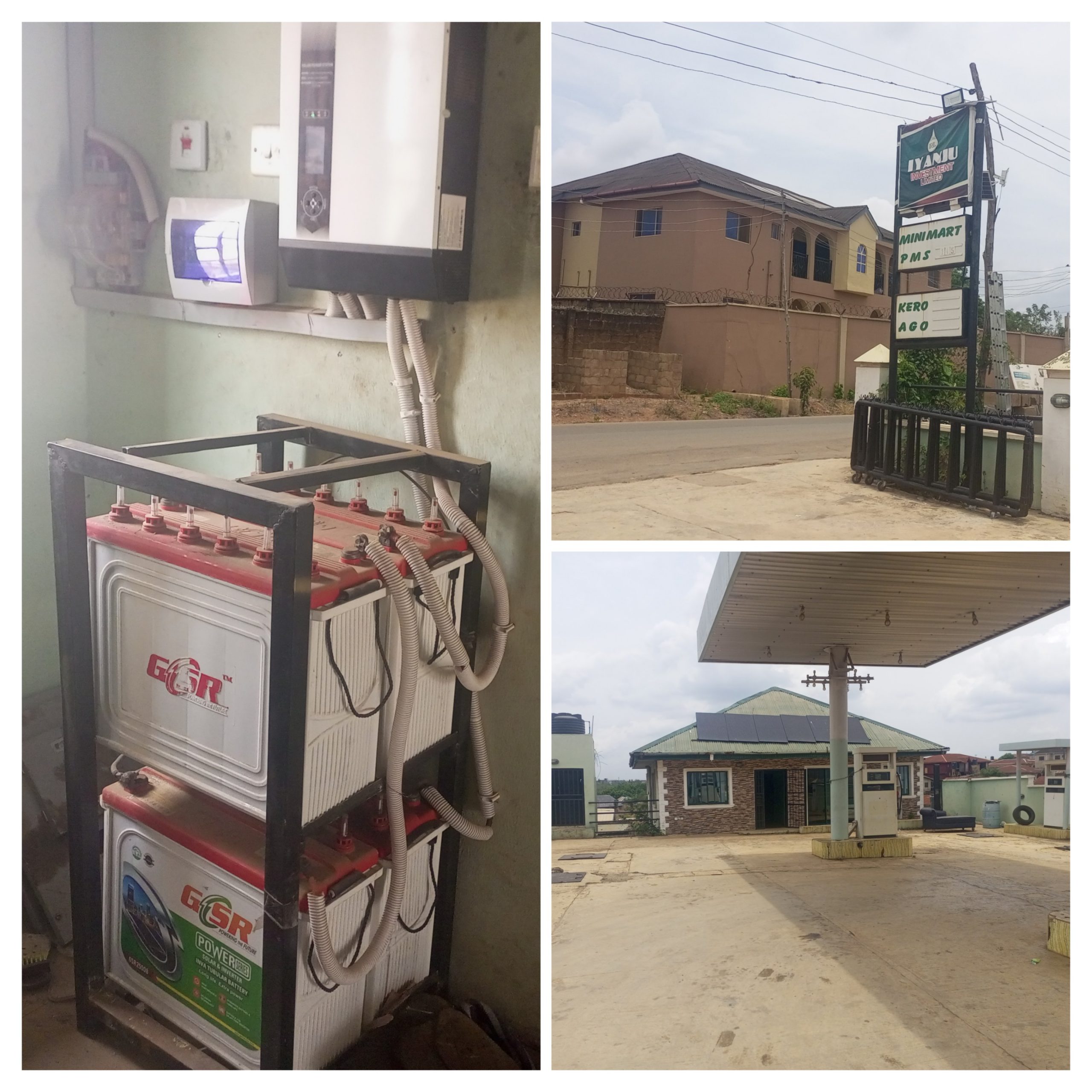
One striking example in the development are the fuel stations using solar power instead of maximizing the availability of the diesel they sell.
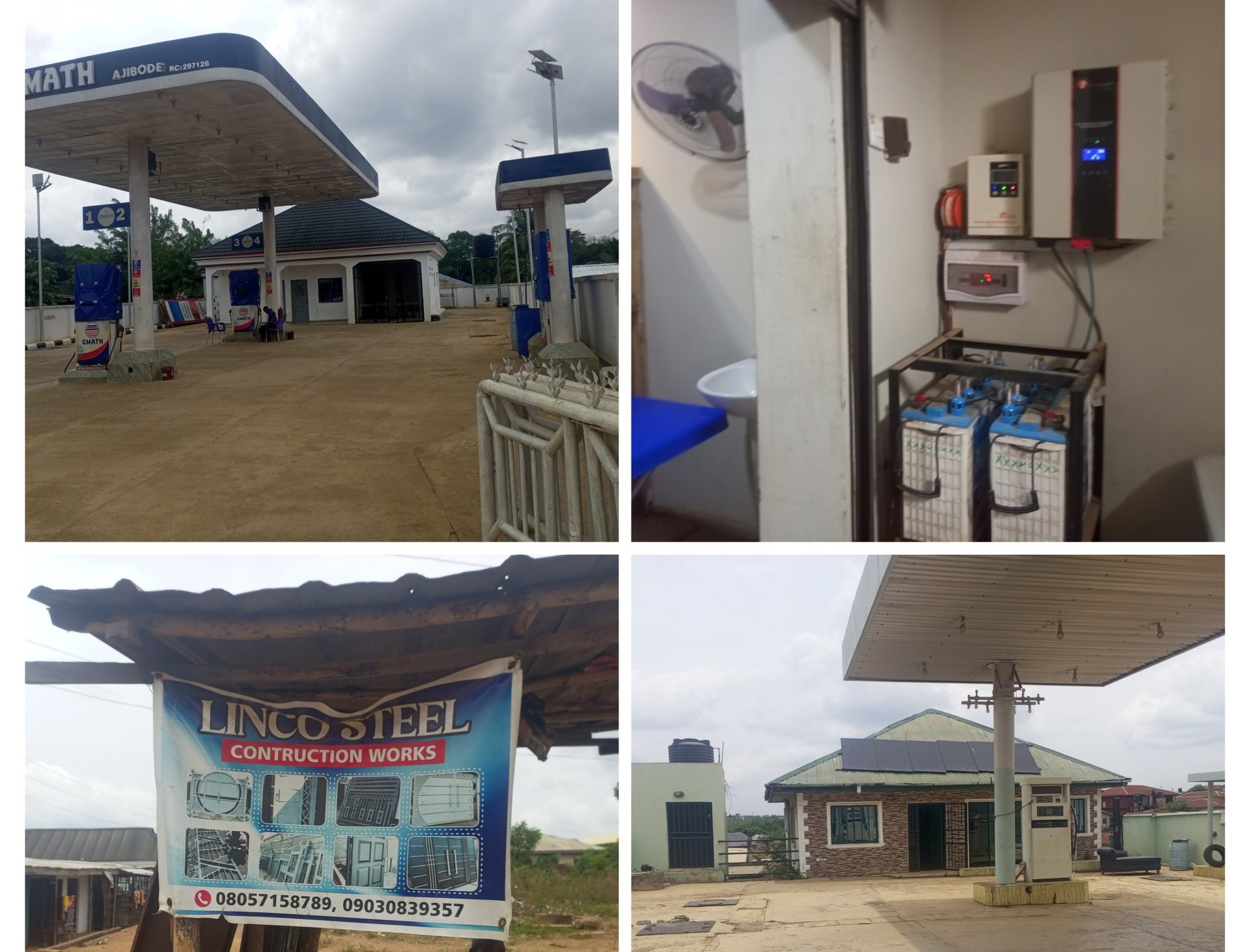
In an interview with Mr. Sodiq, a petrol attendant at Gmath Filling Station, he disclosed that the company has stopped relying on electricity supply and has since installed solar panels to generate power for its operations.
“We have been using 24-hour solar power for about two years. We operate our fuel pumps effectively. The solar works well, except when it rains. We still use a prepaid meter, but the electricity is not useful to us,” he said.
He added that electricity supply is nothing to write home about, as it returns to its poor state even after repairs.
“If they repair the electricity, it will spoil again,” he noted.
Another station manager, Mr. Kolade of Iyanuoluwa Investment Limited, also recalled the challenges faced by residents. He noted that electricity is no longer a priority, as they barely enjoyed up to 20 minutes of power supply in February. At the station, he noted that they have adopted solar power, which provides uninterrupted electricity for about 14 hours during business operations.
“The solar we use runs from 6:30 a.m., when we open, to 9:30 p.m., when we close. The downside is the high cost of installation. We are using a 5kVA, 12-panel solar system estimated at ₦3.2 million. It powers two fuel pumps and a refrigerator. For the past year, after we shut down in 2021, we have relied on solar. Rain does not significantly affect the setup,” he disclosed.
Other Establishments Adopt Solar Power and Generators as Alternatives
As filling stations migrate to alternative power sources, other business owners are not left behind. Instead, they are embracing these alternatives and absorbing the associated risks.
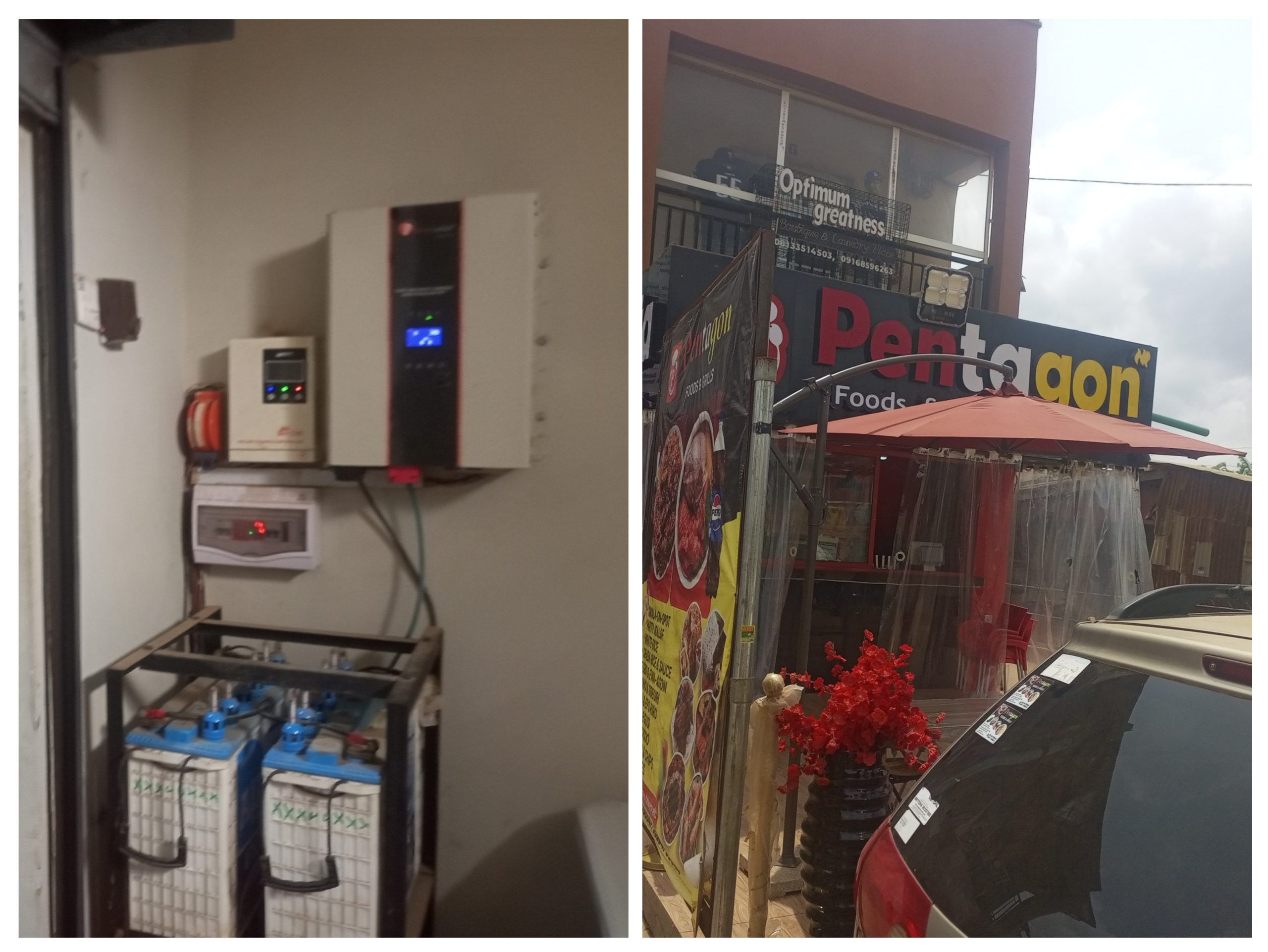
At Pentagon Food and Grills, opposite Ajibode Primary Healthcare Centre, management has devised a system that combines generator and solar power to ensure a steady electricity supply. They also operate a business centre where customers can browse the internet and carry out other online activities.
“We use both generator and solar power. Before the increase in fuel prices, we spent about ₦5,000 on fuel, but now we spend around ₦7,000. When the solar switches off at about 5:00 p.m., we start using the generator. During that period, the generator powers the restaurant and charges the solar battery. When the fuel is exhausted, the solar switches back on because it has already been charged,” Mr. Asunloye Timilehin, the manager, told AfrikTimes.
He also noted that although the business is connected to the national grid, they rarely rely on it due to its inconsistency.
“I am yet to print airtime cards for customers”— Miss Bukola
While Pentagon that relies on two alternatives and rarely anticipates electricity supply from the national grid, the situation is different for Mrs. Bukola, who manages an Airtel-affiliated shop for her employer. She was seen sitting on a long chair inside the shop, waiting for her generator mechanic after it developed a fault. She had been waiting for over three hours and had been unable to print airtime cards or carry out other essential services when AfrikTimes visited.
“Customers have been waiting for me to deliver their items, but there is no light to print the cards, and the generator we use has developed a fault. Most shop owners here have alternative outlets outside the community. Even the mechanic who will repair the generator is coming from another outside,” she lamented.
Like others interviewed by AfrikTimes, she noted that electricity supply has been in a prolonged state of failure. She added that the daily cost of fuel is not economical, as it is difficult to increase the price of airtime cards.
“I have been here for two years. When there is electricity in the morning and it lasts for some time, you may not get it again for the rest of the month. We use generators every day, and it is not profitable. We cannot increase costs. I don’t even know how to recharge the prepaid meter. For the past two years, we have not exhausted the units on it,” she said.
In her case, the local government appears to have added to the burden rather than providing support. She presented a notice to AfrikTimes indicating that shop owners had been given a seven-day ultimatum to pay ₦20,000 as internally generated revenue, an increase from the previous ₦5,000.
One may ask how business owners, who already spend heavily on alternative power supply, are expected to meet such demands. The idea looks far-fetched from reality as it lacks empathy and selflessness.
“The Downside Outweighs the Benefits”— Mr Samuel, electronics dealer.
Mr. Samuel, a dealer in household electronics, believes that the absence of electricity has created an opportunity for dealers like him to sell power banks, portable fans, rechargeable bulbs, and similar items in larger quantities. However, he acknowledged that the situation has negatively affected the productivity of other businesses.
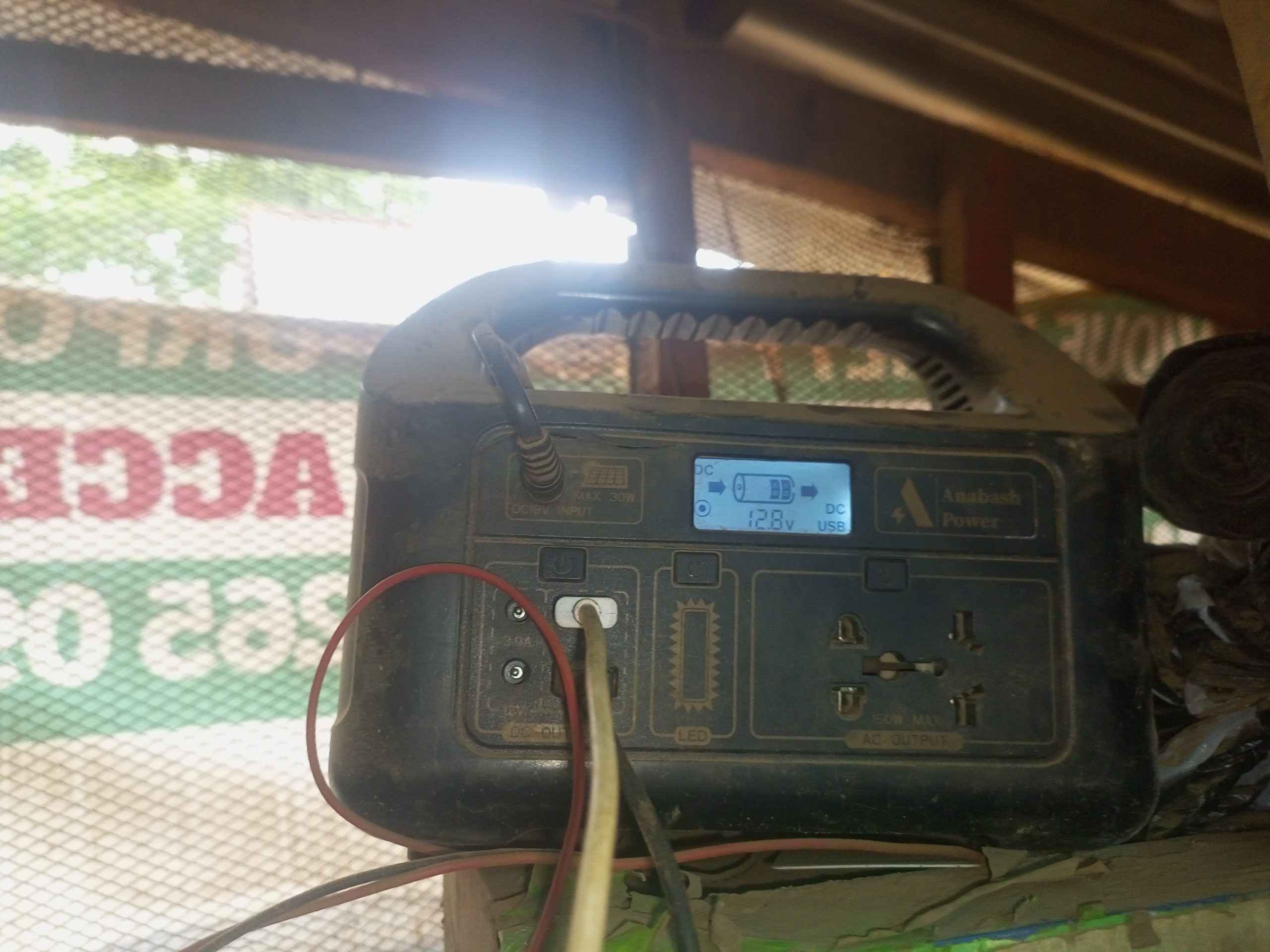
“People buy power banks, rechargeable fans because of the heat, and bulbs. But the lack of electricity is affecting businesses like welding and tailoring. The negativity outweighs the positivity.”
When asked to provide context for the poor electricity supply in the community, he noted that there was a ruckus during which Ibadan Electricity Distribution Company (IBEDC) workers were physically assaulted by residents, leading to a prolonged stalemate in electricity supply. He further explained that a change in the supply line from Sasha to Apete contributed to the violence.
“I have been here for about five years, and the issue has been ongoing for about 10 years. They beat the IBEDC workers, and the electricity supply stopped completely. Before the assault, the supply line was changed from Sasha, which had better electricity, to Apete, which is worse. The situation is almost the same as Apete because we get electricity from there.”
Like other business owners, Mr. Samuel has installed a solar panel on the corrugated roofing sheet of his shop. The panel is connected through a DC cable to the power station that houses the battery, enabling him to power devices when needed. He uses the solar system to run his shop during the day and especially at night.
To verify his claims, AfrikTimes visited Osanji-Beere, around the Apete axis, to speak with residents. In a conversation with AfrikTimes, Mr. Ajibade, a welder, confirmed Mr. Samuel’s account. He noted that despite a previous agreement with the electricity distribution company to supply power for four hours daily, there is currently nothing to show for it.
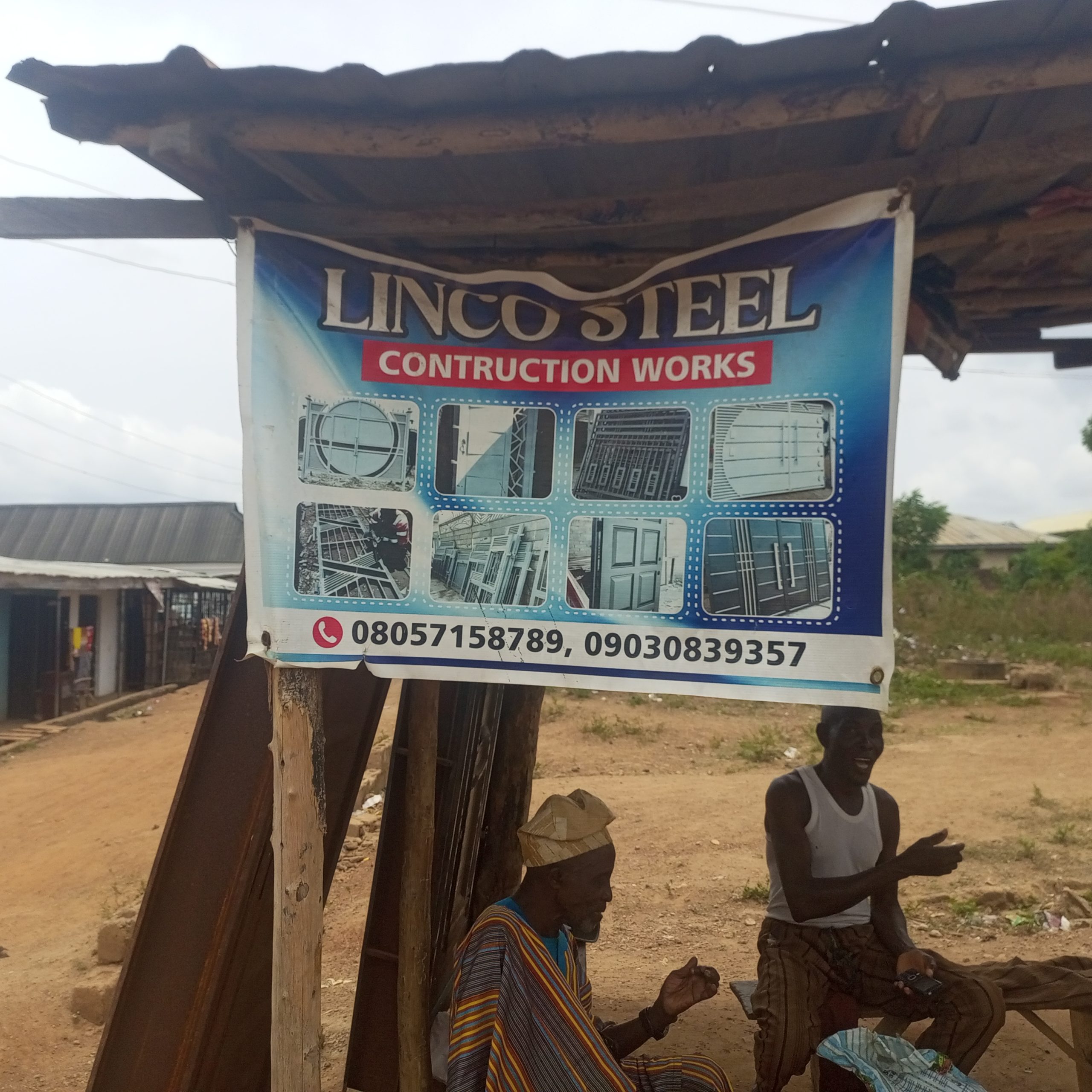
“Last year, we had a four-hour daily agreement with IBEDC. This was after community house agents manhandled the company workers due to poor electricity supply. Now, we do not even get electricity for up to two hours in a week. The so-called IBEDC workers no longer come to distribute bills or collect payments for previous ones,” he said.
As a welder, he explained that he needs to increase the cost of his services to make a profit, as relying on fuel is expensive.
“If I want to work, I use a generator. Now, I need to fix a door for a neighbour and my fee is #10,000. After buying two litres of fuel and pushing the generator down there, it cannot be cheap,” he added.
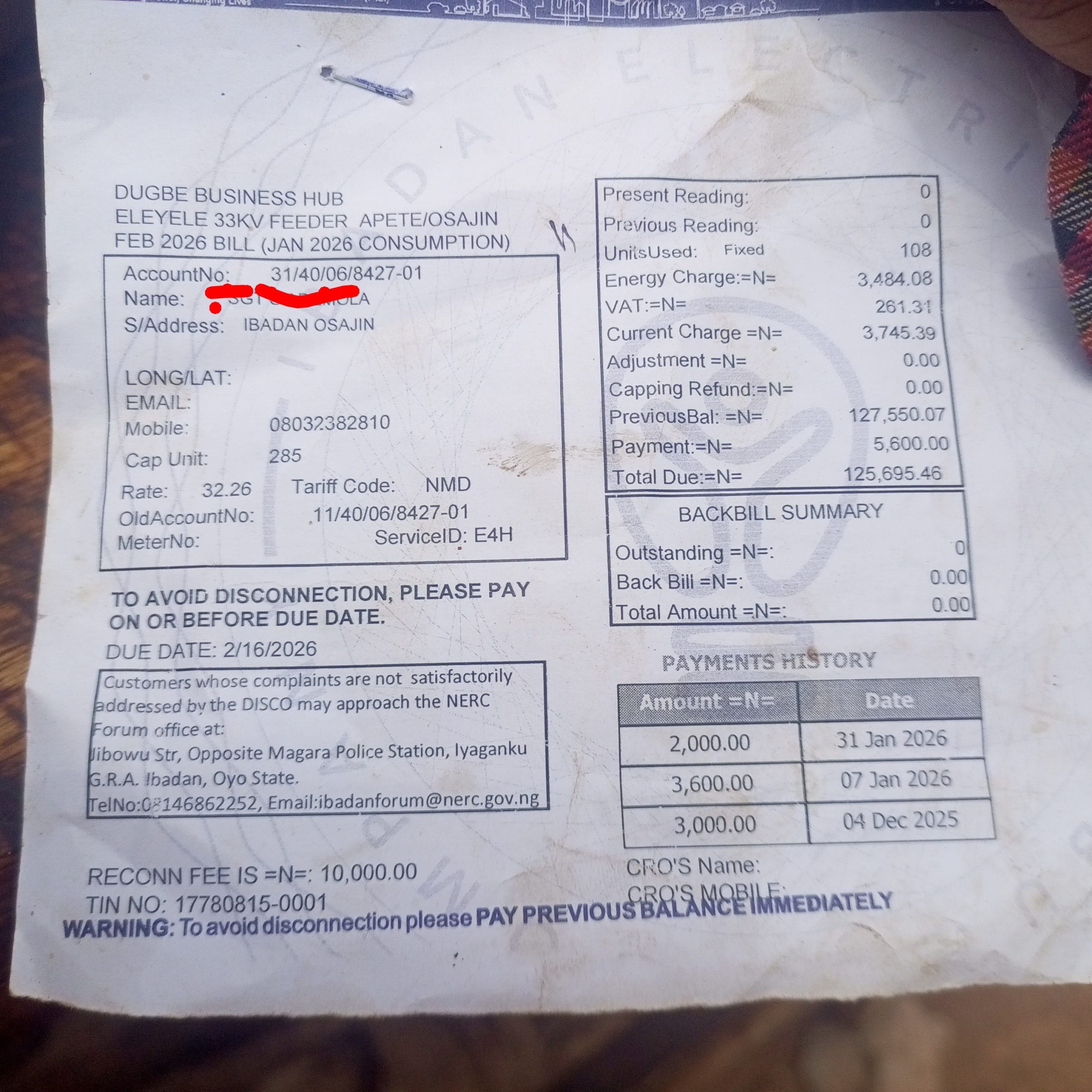
Another resident who spoke with AfrikTimes, Mrs Aminatu, provided copies of both previous and current electricity bills to show that despite not having proper power supply, IBEDC still charges the community. Like some residents, Mrs. Aminatu now has solar power she pays for in installments.
Housing in Ajibode
Considering the state of electricity in Ajibode, one might assume that housing costs would be lower compared to other communities in Ibadan. However, further investigation by AfrikTimes revealed that rent prices are relatively similar to those in neighbouring areas.
Speaking with AfrikTimes, Mohammed Kehinde, a resident, disclosed that the cost of accommodation remains high, compounded by the excessive fees charged by house agents.
“The cost of accommodation is the same as in places like Agbowó and Orogún, with agents charging exorbitant fees and using proximity to UI (claiming it is just a 3 to 5-minute walk to the gate) to market vacancies,” he said.
Houses equipped with solar panels are often more expensive than those where tenants are left to provide their own alternative power. Despite this, residents continue to adapt to the persistent lack of electricity.
Behind the Popular Solar Panel
The cost of solar power systems in Nigeria varies depending on capacity, type, and brand. There are solar solutions designed for low-income households, typically ranging from 10W to 100W and above. These systems usually cost between ₦25,000 and ₦200,000 as a one-time purchase. They are mostly DC-based systems, meaning they do not require expensive inverters. They can power essential appliances such as LED bulbs, mobile phones, and in some cases, rechargeable fans or power banks.
There is also the option of installment payments; however, the total cost becomes higher over time due to interest, increasing the financial burden.
Standard households often use inverter-based systems ranging from 1kVA to 3.5kVA. These installations cost between ₦650,000 and ₦4.2 million, depending on battery capacity and components. At this level, households can power appliances such as refrigerators, freezers, and air conditioners.
For larger residences, offices, or commercial buildings, high-capacity systems ranging from 5kVA to 15kVA and above can cost from ₦4.5 million to over ₦35 million for industrial-grade setups. These systems are capable of running multiple air conditioning units, pumping machines, and heavy electronics simultaneously, similar to those used by petrol stations
The Ongoing Electricity Crisis in Nigeria
Nigeria’s electricity crisis has reached a critical breaking point in 2026, with millions of citizens living in prolonged darkness as the national grid continues its pattern of frequent collapses. Despite repeated promises of reform, the Tinubu-led administration is facing intense backlash for failing in its fundamental duty to provide a stable power supply.
A primary driver of this systemic failure is the acute shortage of natural gas, which powers over 70% of the country’s thermal generating stations. Distribution companies and the Nigerian Independent System Operator (NISO) have reported that generation levels have plummeted because there is no longer enough gas to operate these stations at optimal capacity. With thermal plants requiring nearly 1,600 million standard cubic feet of gas per day but receiving only about 40% of that volume, several generating units have been forced offline.
The situation has become so dire that the Minister of Power, Adebayo Adelabu, was recently compelled to issue a formal public apology to the nation. During a press conference in Abuja, Adelabu appealed to Nigerians for patience, admitting that the persistent outages during the intense dry-season heat have caused “deepened hardship.” While he attributed the crisis to factors he described as beyond the government’s immediate control, such as pipeline maintenance and liquidity challenges, his plea was met with skepticism by a public already fatigued by recurring excuses.
Consequently, distribution companies (DisCos) like IBEDC often find themselves receiving zero or near-zero megawatt allocations from the grid, leaving them unable to meet the demands of their customers.
“We Are Currently Engaging Relevant Stakeholders”— IBEDC Lead Media Relations
When speaking with AfrikTimes through a phone conversation, the IBEDC Lead Media Relations, Mr. Daniel, revealed that the company is currently engaging concerned stakeholders in the power chain. He also attributed the low power supply customers are receiving to the ongoing nationwide reduction of power from the national grid.
“We apologize for the inconvenience caused by the power supply challenges affecting customers in those areas,” he said.
“We have explained severally that the supply constraints being experienced across parts of our network are largely linked to challenges affecting power generation and supply on the national grid.
“IBEDC has been actively engaging community leaders and stakeholders across our coverage areas to foster mutual understanding of the situation and to work together towards sustainable solutions. We recently held engagement with representatives of communities including Ajibode to explain these challenges to them.
“We are also actively engaging relevant stakeholders within the power value chain to address the imbalance in energy allocation, restore stability to the grid, and improve electricity supply to customers,” Mr. Daniel added.
What is the Hope of the Common Man?
While the idea of adopting solar power appears innovative and appealing, critical questions remain: how do we expect people to establish businesses in the community when their very existence is threatened by the erratic power supply? In a country where 133 million people are multidimensionally poor, how can a household living below the ₦70,000 minimum wage afford a ₦150,000 solar system capable of powering basic appliances such as phones, power banks, fans, and light bulbs?
For many Nigerians, solar energy is not a realistic solution but an expensive alternative forced by necessity. The real solution lies in the federal government addressing the deep-rooted decay in the electricity sector and ensuring that Nigerians can live and operate in a stable and functional power environment.
Until these structural issues are addressed through deliberate efforts, investment in infrastructure, and accountability across all levels of the power sector, the electricity crisis in Nigeria is likely to persist, leaving households and businesses to rely on costly and unsustainable alternatives.