


 By
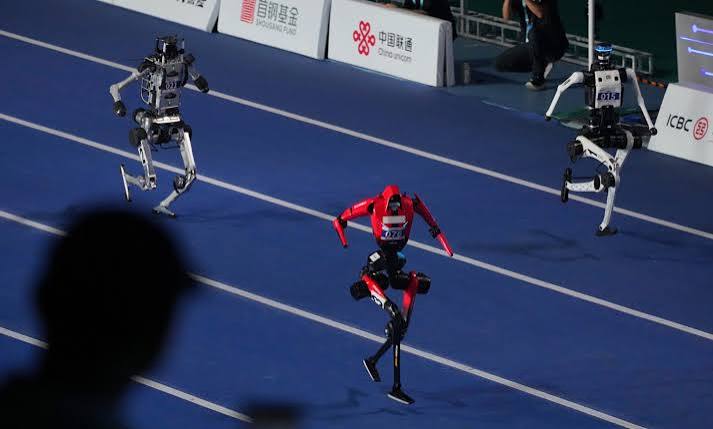
By A crowd that came expecting stiff, clumsy machines instead watched a faceless humanoid do something no human ever has, beating Usain Bolt’s own numbers on a track built for people, not robots. Over the weekend, China’s World Robot Games turned Beijing’s Olympic speed skating arena into equal parts sporting arena and comedy stage, as dozens of humanoid robots and their human handlers competed across athletics, boxing, football, and martial arts.
A Machine Faster Than the Fastest Man Alive
The headline moment came during Saturday’s opening ceremony, when a stark white, headless robot named Tiangong Ultra tore through the 100 metre dash in 9.39 seconds, according to state broadcaster CCTV, a tick quicker than the 9.58 seconds Bolt clocked when he set the still-standing human world record back in 2009. Chinese state media wasted no time celebrating the milestone.
The same robot was not finished. On Sunday, Tiangong Ultra returned to shatter the 400-meter world record too, this time by close to five seconds, crossing the line in 38.16 seconds, a figure later adjusted slightly to 38.15. The machine, built by a Beijing government-backed research centre, has now rewritten two of track and field’s marquee sprint distances in a single weekend, feats no flesh-and-blood athlete has matched.
Grace Was Optional
Not every robot on the track looked like a record breaker. In one 400-meter heat, spectators held their breath as a white-shelled competitor flailed its arms wildly from side to side, tilting forward at an alarming angle that had fans openly wondering if it was about to topple over. It wobbled its way to the finish but somehow stayed upright.
Plenty of others were not so lucky or did not try. Some robotic runners failed to leave the starting line at all. Others shuffled around the track at little more than a walking pace, and a few collapsed the moment the starting gun fired, drawing as much delight from the crowd as the champions did.
Football proved just as chaotic and just as charming. Children and parents alike laughed as a toddler-sized humanoid booted the ball clean off the pitch and over knee-high barricades, with every scrappy, barely contested goal earning a fresh wave of applause from the stands. In the boxing ring, one humanoid competitor stumbled sideways mid-bout and folded over the ropes, remaining completely motionless until human handlers stepped in and carried it away, sending the crowd into laughter.
“It’s Not a Test of Intelligence”
Among those watching was 72-year-old Beijing retiree Hou Yali, who said the weekend’s record-breaking runs left her curious to see humanoids eventually face off directly against people. She noted that speed alone does not tell the full story of what these machines can do, pointing out that outrunning a human is a different challenge from handling household chores or acting as a live-in companion or aide.
Hou, who currently pays human helpers to clean her home and cook her meals each week, said she would welcome robots taking over those same duties. As the country’s economy continues to grow and households have more disposable income, she suggested, more Nigerians and Chinese alike may eventually choose robotic help over human labour.
Background
The 2nd World Humanoid Robot Games form part of China’s broader push to position itself as the global leader in humanoid robotics, an industry increasingly viewed as a marker of technological prestige alongside more traditional benchmarks like semiconductors and artificial intelligence. Saturday and Sunday’s events, drawing dozens of competing teams and their machines, doubled as both a technical showcase and a public spectacle, blending genuine engineering breakthroughs with the kind of unscripted stumbles that made for some of the weekend’s most memorable moments.