

 By
By Thinking Machines Lab, the San Francisco AI startup founded by former OpenAI chief technology officer Mira Murati, released its first foundation model on Wednesday, July 15, 2026. It launched as an open-weight system called Inkling, which the company is positioning as a customizable alternative to the closed models sold by larger rivals.
It is the company’s first general-purpose model since it launched Tinker, its AI fine-tuning platform, last October. Consequently, this new model arrived more than a year after Thinking Machines was founded amid heavy investor interest but before any product had shipped.
What Inkling is
Inkling is a Mixture-of-Experts transformer with 975 billion total parameters, of which roughly 41 billion are active for any given task. It is a design that keeps very large models cheaper and faster to run. The company contends that it was pre-trained on 45 trillion tokens ranging from text, images, audio, and video and supports a context window of up to one million tokens.
The model thinks natively across text, images, and audio, though outside reporting on the release notes that its outputs remain limited to text and code for now. Alongside Inkling, Thinking Machines previewed a smaller sibling, Inkling-Small, a 276-billion-parameter model with 12 billion active parameters that is still being tested; the company plans to release its full weights once that work is complete.
A distinguishing feature is “controllable thinking effort,” paving the way for developers to dial reasoning depth up or down to trade accuracy against cost and latency. Thinking Machines says that on one coding benchmark, Inkling matches Nvidia’s Nemotron 3 Ultra using roughly a third as many tokens.
Where it stands against rivals
Thinking Machines was candid that Inkling is not a frontier-beating model. Its own release notes state plainly that it is “not the strongest model available today, open or closed,” and its published benchmark tables show it trailing closed systems from Anthropic, Google, and OpenAI, as well as some open Chinese models, on several reasoning and coding measures. The company instead emphasizes breadth, efficiency, and Inkling’s strong showing on agentic tasks, plus what it describes as leading built-in safeguards among open-weight models it compared itself to.
Outside coverage has also raised the question of how Inkling was built. According to the company’s own materials, part of its early post-training data was generated using other open-weight models, including Moonshot AI’s Kimi K2.5, before large-scale reinforcement learning took over, which is a practice known as distillation that has drawn scrutiny industry-wide. Thinking Machines has said future models will rely on fully self-contained post-training instead.
The bigger strategic bet
Analysts covering the release frame Inkling as filling a gap in the US open-weight market. Meta, once the leading champion of open models, has been shifting toward closed, monetizable systems, while OpenAI’s open releases from last year remain a small part of a business still dominated by paid products. That has left much of the freely downloadable AI landscape in the hands of Chinese labs, fueling US policy concerns as cost-conscious developers turn to those models.
Thinking Machines says it isn’t trying to monetize Inkling directly. Its revenue instead comes from Tinker, the fine-tuning platform it sells to enterprise customers, reportedly including the hedge fund Bridgewater Associates, which aims to adapt models like Inkling to specialized tasks. Company materials describe Inkling as functioning as the reasoning engine behind “interaction models,” a separate effort Murati has described as letting people collaborate with AI more the way they do with other humans, picking up on cues like pauses and interruptions rather than only text prompts.
Thinking Machines raised $2 billion at a $12 billion valuation in 2025 and was reported to be in talks for a much larger follow-on round, even before shipping a product. The company has also seen departures, including co-founders who left for OpenAI earlier this year, and now employs roughly 200 people.
Access Issues During Rollout
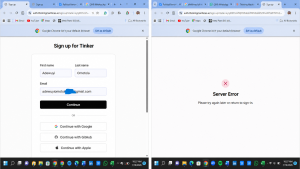
In the course of reporting this story, an attempt to independently verify Thinking Machines’ claims by creating a Tinker account to test Inkling directly was unsuccessful. AfrikTimes’ reporter repeated sign-up attempts from Nigeria but encountered a server error, and the registration flow looped back to the same landing page without completing. The issue has been reported to Tinker’s support team, and a response is pending. It isn’t clear whether the fault reflects a regional access restriction, a broader bug, or a rollout day capacity issue, and this report will be updated if the Support Team replies or if that situation changes.
Inkling’s full weights are available now on Hugging Face, and the model is live for fine-tuning on Tinker with 64K and 256K token context options, at a temporary 50% pricing discount.