

 By
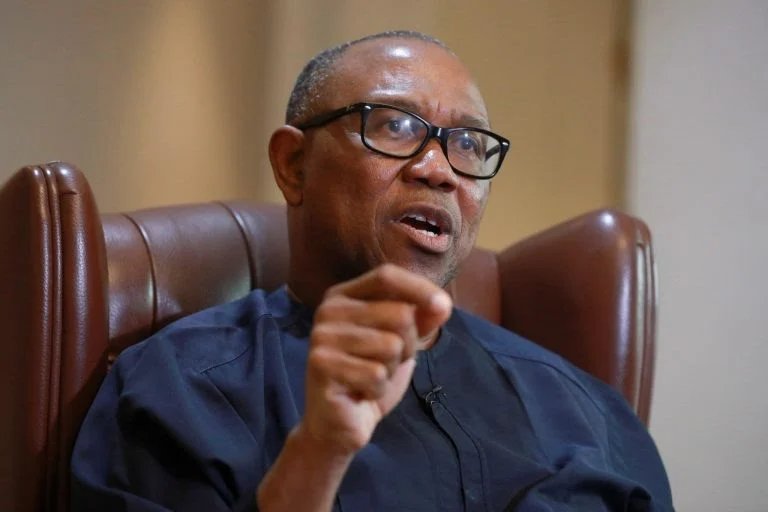
By A planned visit by Nigeria Democratic Congress presidential candidate Peter Obi to grieving families in Yelwata, Benue State, collapsed on Tuesday after youths barricaded a major Makurdi road and turned his convoy back, triggering a public blame game between Obi and the Benue State Government even as police confirmed they had been notified of the trip in advance.
The Blockade
Obi had travelled to Benue intending to condole with families of victims of the Yelwata massacre, in which more than 200 people were reportedly killed over roughly a day of violence between June 13 and 14, 2025. His convoy was stopped on Gboko Road near Gyado Villa, close to the Nigerian Air Force Base and Makurdi Airport, where protesters blocked the route and chanted that they did not want him in the area. The standoff disrupted traffic in the area for hours and ultimately forced Obi to abandon the trip and fly back to Jos, Plateau State, without reaching Yelwata.
Speaking at the scene in footage carried by News Central Television, Obi said he had been told that youths mobilised by a Special Assistant to the state government were behind the roadblock, and specifically deployed to stop him from proceeding. He called the episode unacceptable, arguing that the very youths used to block him are themselves victims of the poverty and insecurity plaguing the state, and should not be turned into political tools. He described travelling a long distance that morning only to be met with the blockade, and said the disorder now being imported into the country’s politics could not be tolerated, especially given the scale of ongoing killings in Benue.
Benue Government Denies Involvement, Cites Missing Notification
The state government firmly rejected any role in organising or sponsoring the blockade. Commissioner for Information and Orientation Solomon Iorpev said Obi had failed to formally notify the state government of his visit, arguing that as a former governor and sitting presidential candidate, his movements required proper security coordination that the state could not provide without advance notice. Iorpev said the government bears responsibility for the safety of high profile visitors but cannot discharge that duty without being formally informed, adding pointedly that this was not the first time Obi had visited without such notice and suggesting he was, in his words, looking for trouble despite Benue’s reputation for hospitality.
Iorpev said he did not know the identity of the youths involved, floating the possibility that their presence coincided with an unrelated gathering of youths from several of the state’s local government areas, including Tarka, Gboko, Buruku, Ushongo, Konshisha or Vandeikya, though he stopped short of confirming this explanation.
The Chief Press Secretary to Governor Hyacinth Alia, Kula Tersoo, went further, issuing a statement flatly denying that the Alia administration had any knowledge of or connection to the incident. Tersoo questioned whether Obi had even visited Makurdi that day, citing what he called a pattern of untrue statements from Obi about the state, and argued that the governor had no reason to view Obi as any kind of threat requiring interference. He maintained that recognised security agencies, not political actors, are responsible for managing security concerns around high profile visitors, and insisted the Alia administration does not use thuggery as an instrument of governance.
Tersoo argued that if the visit truly lacked formal security coordination through the Commissioner of Police and other relevant agencies, that omission itself was curious for someone presenting himself as a presidential candidate. He suggested that any internal disputes within Obi’s own party structure in Benue should be resolved inside the party rather than attributed to the state government, and said the Alia administration would not be distracted from its focus on governance, security and the welfare of Benue residents, while inviting political actors who visit peacefully to continue doing so.
Police Account Complicates the Government’s Position
The police version of events cut against a central plank of the state government’s defence. Commissioner of Police Cletus Nwadiogbu confirmed that the command had indeed been notified of Obi’s visit, and said he personally directed the Assistant Commissioner of Police for Operations to lead officers assigned to provide Obi’s security. Nwadiogbu said that on arrival, officers found youths had already blocked the road specifically because they did not want to see Obi, prompting an investigation into why the protest took the form it did. He described the situation as tactically managed for the moment but said police were not letting the matter drop, and called Obi a very responsible man, confirming that the candidate ultimately turned back and left once the blockade became clear.
Police command spokesperson DSP Peter Aondongu had earlier confirmed the same basic sequence, that officers were deployed for Obi’s movement toward Yelwata, that the reason for the blockade remained unknown at the time, and that the command was actively investigating the circumstances, with further updates promised as the inquiry progressed.
NDC’s Benue Governorship Candidate Pushes Back
Professor Terhemba Shija, the NDC’s governorship candidate in Benue State, disputed the state government’s central complaint, saying the party had duly informed both police and the Department of State Services ahead of the visit, and that both agencies deployed personnel accordingly. He argued that with INEC having lifted its ban on campaign activity, a presidential candidate should not need separate permission from the state government simply to visit bereaved families, framing the trip as a solidarity visit rather than a campaign rally. Shija described the blockade as a demonstration of fear and, in his words, clear proof that Obi is the man to watch, questioning why a legitimate candidate who had already notified the Commissioner of Police and DSS should be stopped from seeing grieving families.
Obi Turns to Plateau, Highlights Displacement Crisis
After leaving Benue, Obi travelled to Jos, Plateau State, where he visited a community in Mangu Local Government Area recently affected by attacks and voiced concern over prolonged killings and displacement in the state. He told internally displaced persons at the camp that as long as they remained displaced, the country itself remained displaced, and that Nigeria would only be truly at home once they returned to theirs.
Obi called on the Federal Government to take decisive action against killings, kidnappings and displacement in Plateau and Benue alike. While acknowledging the value of prayer, he argued government bears the primary responsibility for protecting lives and prosecuting those responsible for violence, noting that the perpetrators are not strangers from elsewhere but people the country is capable of identifying and confronting. He cited a displacement figure of roughly 45,000 people from more than 20 communities in Plateau as unacceptable, and lamented the disruption to children’s education caused by the destruction of their communities. Describing it as his third visit to affected areas in the state, during which he had supported the construction of a school and provision of water, Obi said he had not come to campaign but to assure residents they remained in his thoughts, expressing hope that a future visit would find them already returned home.
Political Reaction Pours In
The incident drew swift condemnation from figures across party lines. PDP governorship candidate in Benue State, Chief Michael Aondoakaa, called the blockade an assault on democracy and constitutional rights, arguing that no individual, group or government has the authority to deny any Nigerian access to any part of the country over political affiliation. He said the episode ran contrary to a recently signed political peace accord under which parties had committed to issue based, non-violent campaigning, and while cautioning against judging all of Benue by the actions of a few, he called for an impartial investigation and prosecution of those responsible.
The NDC itself demanded an immediate investigation and the arrest of those involved, with National Publicity Secretary Osa Director describing the blockade as disturbing and reaffirming that Obi’s visit was meant to identify with Yelwata’s victims. The party said it would not be deterred from its broader mission of holding government accountable for protecting Nigerian lives, and called on the Benue State Government and security agencies to investigate, identify perpetrators and guarantee safety for citizens and leaders alike who wish to show solidarity in moments of grief.
Former Sokoto State Governor Aminu Tambuwal condemned the incident in a post on X, describing the obstruction as unacceptable and undemocratic, and stressing that Obi, as a Nigerian citizen, former governor and recognised presidential candidate, retains the constitutional right to move freely and campaign without intimidation. Tambuwal warned that democracy cannot function if political actors or their supporters get to decide who may enter which part of the country, and called on the Inspector General of Police and relevant security agencies to investigate and hold those responsible accountable, warning that today’s target could easily be a different candidate tomorrow.
The National Electoral Accountability Consortium and the Tap Initiative for Citizens’ Development also weighed in, saying video and eyewitness accounts showed individuals blocking the road and approaching vehicles in Obi’s convoy, though they noted the identities and motives of those involved remained unconfirmed and called for an independent investigation. The groups said the incident was troubling regardless of who was involved politically, and cautioned all parties and candidates against inflammatory rhetoric or mobilising supporters against opponents as the 2027 cycle intensifies, urging security agencies to guarantee that political actors can move and campaign freely.
Not the First Clash Over Access to Benue
Tuesday’s standoff is not the first friction between Obi and the Benue State Government over a proposed visit. In April 2025, Obi alleged he had been blocked from visiting the state on a humanitarian mission, an earlier episode that echoes Tuesday’s dispute.
Background
The incident lands as Nigeria’s political parties ramp up activity following INEC’s lifting of restrictions on campaigning ahead of the 2027 general election, a period marked by opposition parties pushing to expand their reach into states traditionally seen as strongholds of rival parties, and rising political tension as candidates jostle for visibility and access across the country.