


 By
Election results expose growing divisions within Haredi society and raise questions about the future of its longstanding alliance with Netanyahu
One of the most significant developments in the aftermath of the Israeli elections was the decision by United Torah Judaism (UTJ), the main ultra-Orthodox Jewish party, not to recommend Benjamin Netanyahu to form the next government.
This marks a departure from years of close alliance between Netanyahu and the ultra-Orthodox, or Haredi, parties, long considered a pillar of Israeli politics.
Even if the move was tactical, intended to strengthen the Haredi parties’ bargaining position, it sends an important signal, as last month’s vote exposed several significant shifts within Haredi society.
They include the declining standing of veteran political leaders, a struggle over the future of Haredi leadership, the emergence of a new political force challenging established conventions from within, and a deepening crisis surrounding the model of the “society of learners”.
This social model developed in Israel, where Torah study in yeshivas and kollelim has become a central way of life and even a social ideal for Haredi men. Many devote years to religious study instead of entering the labour market or undertaking military service. The model rests on the belief that Torah study is a supreme value and a communal obligation, supported financially by families, the community, the state and religious support networks.
For decades, the Haredi parties were among the most stable and predictable blocs in Israeli politics. They relied on communal loyalty, rabbinical authority and the largely automatic voting patterns of a constituency that sought to preserve its political influence through unified Haredi representation.
That model appears to be beginning to fracture. Beyond how many seats each party won in the parliament, or Knesset, the broader question for many is whether Haredi society remains willing to accept its traditional political leadership without question, or is beginning to demand change, accountability and the ability to confront Israel’s changing reality.
The trauma of the Hamas-led 7 October attack may have bypassed the Haredi spiritual leadership and its veteran MPs, but the wider Haredi public, including the generally more conservative Lithuanian community, understands that something momentous has happened in Israel. This is particularly true of the younger generation.
The traditional divisions between Lithuanian, Hasidic and Sephardi Haredim remain important. But new fault lines are emerging: between younger and older generations, between working Haredim and full-time Torah scholars, and between those seeking greater integration into Israeli society and those who fear that any compromise will undermine the Haredi way of life.
Israel’s regional wars, the question of conscripting yeshiva students, mounting economic hardship among Haredi families and growing tensions between the community and those serving in the military have made these divisions increasingly tangible.
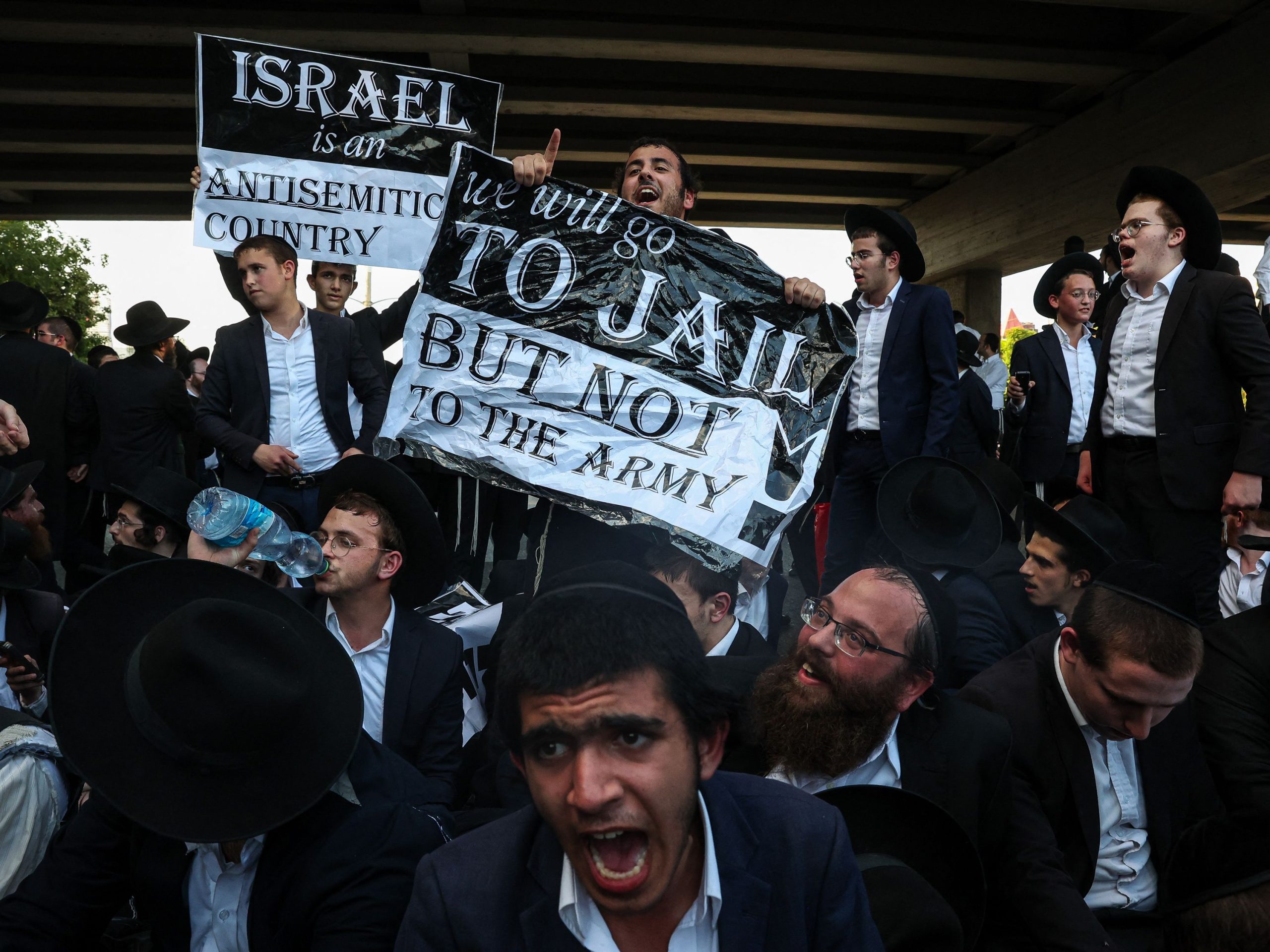
For years, securing the legal status of yeshiva students was a central objective of the Haredi parties. It has now become a dangerous political test. The failure to pass legislation exempting them from military service was not simply a parliamentary setback for UTJ. It exposed the limits of Haredi political leaders’ power and the political price their representatives pay when they fail to deliver on promises to voters.
The changing composition of Haredi political leadership is therefore about more than a reshuffling of personnel. It reflects an attempt to address a crisis of confidence, an increasingly diverse constituency and a political landscape in which even the Haredi parties can no longer take traditional voter loyalty for granted.
 Ultra-Orthodox Jewish men protest in Jerusalem against compulsory military service, on April 11, 2024.
A New Party
The emergence of HaTzibur HaHaredi (“The Haredi Public”), a new Haredi party, is perhaps one of the most significant changes in the Haredi political landscape. Though it won only a tiny number of votes, behind it are rabbis and other influential forces that have broken the longstanding monopoly of established parties over Haredi political representation.
The party seeks to give a voice to Haredim who do not necessarily identify with the agendas of UTJ (Ashkenazi Jews of European origin) or Shas (Sephardi and Mizrahi Jews of Middle Eastern/North African origin), the two parties dominating the Haredi political landscape.
This includes those who believe the existing leadership is primarily concerned with preserving its own power and political machinery. A growing section of the Haredi public is tired of living in isolation, effectively in ghettos within the state. Many believe the rabbis of the Council of Torah Sages, the community’s supreme ultra-Orthodox rabbinical authority, most of whom are approaching 90 or older, are seeking to impose a future of perpetual isolation and poverty.
These new Haredim, who prefer to call themselves “Israeli Haredim”, are advocating a different model. They are raising a fundamental question: can they remain Haredi, preserve their religious and communal identity, and at the same time demand greater integration into Israeli society, greater civic responsibility and a renewed debate about military service?
The party’s emergence presents the traditional leadership with a challenge it has not faced before. Until now, dissatisfied Haredi voters could abstain, support another party or voice their opposition within the community. They now have a political alternative that speaks in a Haredi voice without necessarily accepting the rules of the Haredi establishment.
This does not mean that a new Haredi political camp with substantial electoral strength has emerged. The party’s electoral support remains limited. Nevertheless, its existence could reshape public discourse, bring new issues onto the political agenda and increase pressure on the established parties.
The decision by Dr Nechumi Yaffe, a scholar of Haredi society and political psychology, to join the party and stand as a candidate also signals an effort to broaden Haredi representation beyond the familiar, male-dominated world of political operatives. The change is largely symbolic, but far from insignificant.
Reshuffle
The dramatic removal of Moshe Gafni from the leadership of UTJ was a particularly striking illustration of these developments. Gafni, who had served in the Knesset since 1988 and was long one of the most influential figures in Haredi politics, failed to retain his position.
The official explanation was the need to “refresh” the leadership and bring in new representatives. But the decision reflects a more complex political struggle. The failure to pass legislation exempting yeshiva students from military service, Gafni’s declining influence and the battle for control of the party machinery all contributed to his removal.
The move also exposed a shift in the balance of power within the rabbinical leadership. Rabbi Dov Landau, leader of the Lithuanian Haredi community, and his inner circle sought to ensure greater loyalty from political representatives to the current rabbinical leadership.
Gafni, who had enjoyed considerable independence for years thanks to his experience, connections and political skills, had increasingly become a difficult figure to control.
The removal of MP Uri Maklev alongside Gafni suggests that this was not simply a personal rebuke to the veteran politician. It was part of a broader effort to replace an established generation of politicians and tighten rabbinical control over parliamentary representation.
The decision also reflects a reassessment of the alliance with Netanyahu and the Israeli right. That partnership has carried political costs, including the legitimisation of extreme nationalist positions. It has also contributed to younger Haredi voters shifting their support directly to right-wing parties, particularly Itamar Ben Gvir’s Otzma Yehudit.
Gafni has been replaced by MP Yaakov Asher, who now chairs both Degel HaTorah, one of the main factions of the UTJ, and the alliance overall. A former mayor of Bnei Brak and Knesset member since 2013, Asher is a different kind of political figure. He lacks Gafni’s lengthy parliamentary experience but is regarded as close to and loyal to the Lithuanian rabbinical leadership, particularly Rabbi Dov Landau.
Asher does not necessarily represent a more open approach to changing relations between Haredi society and the state.
However, his record as chairman of the Knesset Interior Committee has earned him praise for his accessibility and ability to build alliances across different groups. These are skills that the veteran Gafni appeared to have lost.
Against the backdrop of a growing, more modern and economically active Haredi public that does not necessarily identify with the traditional leadership, Asher’s remarks in an interview with the Haredi news website Kikar HaShabbat last month were particularly significant.
He explicitly stated that he sees himself as representing both full-time Torah scholars and working Haredim. This is an important message to the younger Haredi generation.
On military conscription, however, Asher takes a hard line. He even resigned as chairman of the Interior Committee in protest at the failure to regulate the status of yeshiva students. Nevertheless, his experience as mayor of the Haredi city of Bnei Brak may give him a practical understanding of both the community’s needs and the workings of government.
The question is whether he can combine these practical skills with his uncompromising position on Haredi conscription.
What is clear is that representatives of the Ashkenazi Haredi community have skilfully positioned themselves as potential partners for both political camps.
UTJ abstained from recommending a candidate for prime minister during consultations with President Isaac Herzog. This has left both Gadi Eisenkot, who has been given a month to form a government, and Netanyahu courting the party’s support.
 An ultra-Orthodox Jewish man prepares to cast his ballot at a polling station in Bnei Brak on October 27, 2026, during Israel’s legislative election.
Shas’ Crisis of Identity
While UTJ is undergoing a major leadership upheaval, the latest election results reveal a different and more acute crisis within Shas, the Sephardi Haredi party: a crisis of identity and representation.
The results dealt the party a severe blow. Shas fell from a peak of 11 seats in the 2022 elections to just six, losing nearly 100,000 votes. The scale of the defeat prompted longtime leader Aryeh Deri to resign. However, the Shas Council of Torah Sages rejected his resignation, prompting him to give up his Knesset seat while retaining his position as party chairman.
Over the past few years, Deri has made several serious political miscalculations. He followed the Lithuanian Haredi leadership’s hard line on military conscription and failed to position himself as a bridge between Haredi society and secular Israelis.
Shas was founded not simply as a Sephardi Haredi party, but as a social and political movement. It gave a voice to a large constituency of Mizrahi and traditional Jews who felt excluded from the centres of power in Israeli society.
Rabbi Ovadia Yosef, the party’s legendary spiritual leader and founder, succeeded in bringing together two worlds: Sephardi Torah scholarship and the wider traditional Jewish public. For many, Shas was more than a political party. It represented identity, dignity and belonging.
After Rabbi Ovadia’s death, Deri managed to preserve the party’s strength, but its centre of gravity gradually shifted. Shas became increasingly identified with Haredi coalition politics and its alliance with Netanyahu.
This may help explain the election results. Haredi voters felt that Shas was not sufficiently Haredi, while traditional voters, many of whom had served in the military, believed it had become too Haredi. They rejected Deri’s position on conscription.
Shas is now caught between two constituencies that once formed the foundation of its strength: a Sephardi Haredi public seeking to protect the world of Torah study, and a broader traditional constituency demanding social representation, economic mobility and a sense of belonging to the state.
The fall to six seats does not necessarily spell the end of Shas. But it confronts Deri with a fundamental strategic question: will the party continue to prioritise its position within the Haredi leadership, or seek to return to its roots as a broad social movement that also represents traditional Jews beyond the Haredi establishment?
Shas recommended Netanyahu to Herzog as its candidate to form the next government. Ultimately, however, its MPs are likely to support whichever government UTJ, the Ashkenazi Haredi party, and its spiritual leader, Rabbi Landau, decide to back.
What Next?
It remains to be seen whether Eisenkot can reach an agreement with Haredi parties to form the next government, ending their almost 17-year-long alliance with Netanyahu.
What is clear, however, is that Haredi society is undergoing several contradictory processes simultaneously.
On the one hand, the rabbinical leadership is seeking to tighten its control over politicians, as demonstrated by the removal of Gafni and Maklev and the appointment of Asher to lead UTJ. On the other hand, there is growing recognition that Haredi society can no longer remain detached from the central issues facing Israel: military service, employment, education, the economy and relations between Haredi and secular Jews.
The latest elections do not yet represent a victory for those seeking change within Haredi society. The new party failed to enter the Knesset, while the established leadership retains its grip on religious and political power.
Yet the younger generation is growing up in a very different reality. Most own smartphones and have access to the internet. They are increasingly exposed to wider Israeli society, face rising living costs and growing concerns about their economic future, and live in a security environment in which military service is anything but an abstract question.
Many remain committed to Torah study, but that does not mean they automatically accept every decision made by their political leaders. Decades ago, Professor Menachem Friedman, one of the pioneers of research into Haredi society, identified an inherent contradiction in the “society of learners” model. He described how, after the Holocaust, rebuilding the yeshiva world became a central Haredi undertaking.
Full-time Torah study gradually evolved from an ideal pursued by a select few into an all-encompassing social norm. Friedman warned that a model dependent on a growing proportion of men not working to support their families could not be sustained indefinitely.
“This is a situation that cannot continue,” he said in a 2012 interview.
Today, for the first time, such criticism is also coming from within Haredi politics. Moti Leitner, chairman of HaTzibur HaHaredi, goes beyond opposing the exemption from military service. He challenges the very economic and social foundations of the society of learners, arguing that the model is collapsing and no longer reflects the realities of many within the Haredi community.
UTJ’s refusal to recommend Netanyahu may ultimately prove to be little more than another tactical manoeuvre in coalition negotiations. But viewed alongside Gafni’s removal, the leadership changes in UTJ, Shas’s declining electoral strength and the emergence of a new Haredi party, it points to a broader transformation.
Haredi society is not yet undergoing a revolution, and conservative forces continue to dominate its centres of authority. Beneath the surface, however, a fundamental debate is taking shape over the very meaning of Haredi identity, the relationship between Torah and the state, military service and employment, and, ultimately, who has the right to speak on behalf of the Haredi public.
 Leader of Shas Party Aryeh Deri leaves his home as he heads to a cabinet meeting, in Jerusalem January 22, 2023.