

 By
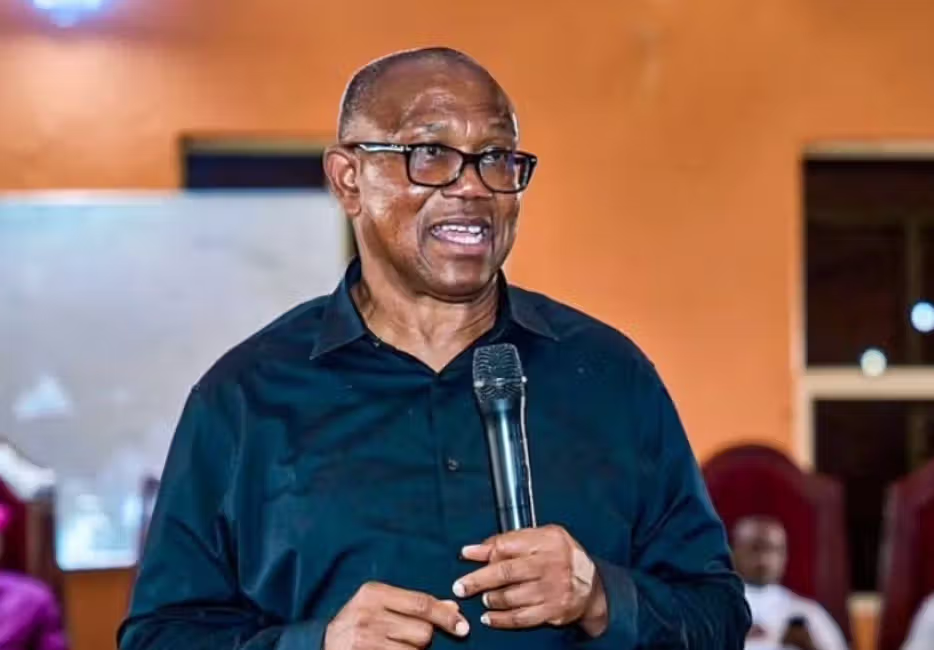
By Peter Obi, presidential candidate of the Nigeria Democratic Congress for the 2027 election, has addressed two major talking points from the campaign trail: his recent comment about being ready to die for the votes of Nigerians, and his plan to set up an independent system for tracking election results.
The former Anambra State governor spoke on both issues during an interview on Arise TV on Thursday.
Clearing Up the “Ready to Die” Comment
Obi’s earlier remark that he was prepared to die to protect the votes of Nigerians had sparked concern in some quarters, with critics reading it as inflammatory ahead of a tense election season. He used the Arise TV appearance to explain the context behind the statement.
According to Obi, the comment surfaced during a recent event in Port Harcourt, where he was mostly listening and responding to attendees rather than delivering a scripted message. One person in the crowd said Nigerians were willing to die to defend their votes, and Obi said he responded in solidarity, describing his own remark as symbolic rather than a literal call to violence.
He said his underlying point was about the integrity of the vote count, not a threat of unrest. His focus, he explained, was on making sure that ballots cast by ordinary Nigerians are properly protected and counted.
A Dual System for Tracking Results
Obi also used the interview to expand on how his campaign intends to safeguard the vote count in 2027. He said his team plans to build a system that captures results directly from polling units and feeds them to his campaign’s situation room, operating alongside the official transmission process run by the Independent National Electoral Commission.
He described this as a dual track setup: one line of results going through INEC’s official portal as required by law, and a second allowing the public to see figures coming out of polling units in parallel.
Asked directly whether expanding this kind of monitoring across the country amounted to creating a shadow vote counting structure, Obi rejected the idea. He argued that the goal was simply accountability at the polling unit level, not a rival system to INEC’s.
He also suggested his campaign would not be alone in this effort, noting that other organisations were likely to deploy similar monitoring tools. The broader aim, he said, was to prevent a scenario where announced results could not be traced back to actual figures recorded at polling units.
Citing Ghana as an Example
Obi pointed to Ghana as evidence that clean, transparent elections are achievable within the region, arguing there was no reason Nigeria could not replicate that standard. He questioned why the country kept associating its elections with controversy and manipulation rather than aiming for simplicity and transparency.
He closed out the interview by framing the 2027 contest in broader terms, describing it not as a fight between political parties but as a standoff between ordinary Nigerians and the government.