

 By
Osun State Governor Ademola Adeleke dissolved the state Executive Council on Wednesday, the same day he presented a N927.37 billion 2027 budget to the House of Assembly and addressed residents in a state broadcast. The three moves came two days before his second-term inauguration, scheduled for Friday, Nov. 27.
In a statement signed by his spokesperson, Olawale Rasheed, the governor thanked outgoing commissioners and other appointees for their service. Speaking in what the statement described as an emotion-laden voice, he reflected on the journey since 2023 and said the team had confronted many challenges, innovated to deliver landmark projects and given up opportunities in pursuit of good governance. He said the council had succeeded where the previous administration failed, pointing to education, health, sports, infrastructure, science and technology, the digital economy and climate change, and added that the administration had won several local and national awards.
He then declared the council dissolved and relieved all political appointees of their positions. Three officials were exempted: the Secretary to the State Government, the Chief of Staff and the Governor’s Spokesperson. Three institutions were also spared; these are: the Local Government Service Commission, the State Universal Basic Education Board (SUBEB) and the recently reconstituted board of Osun State University. Affected appointees were directed to hand over to the directors or permanent secretaries in their ministries, after which outgoing council members spoke about their experience serving under him.
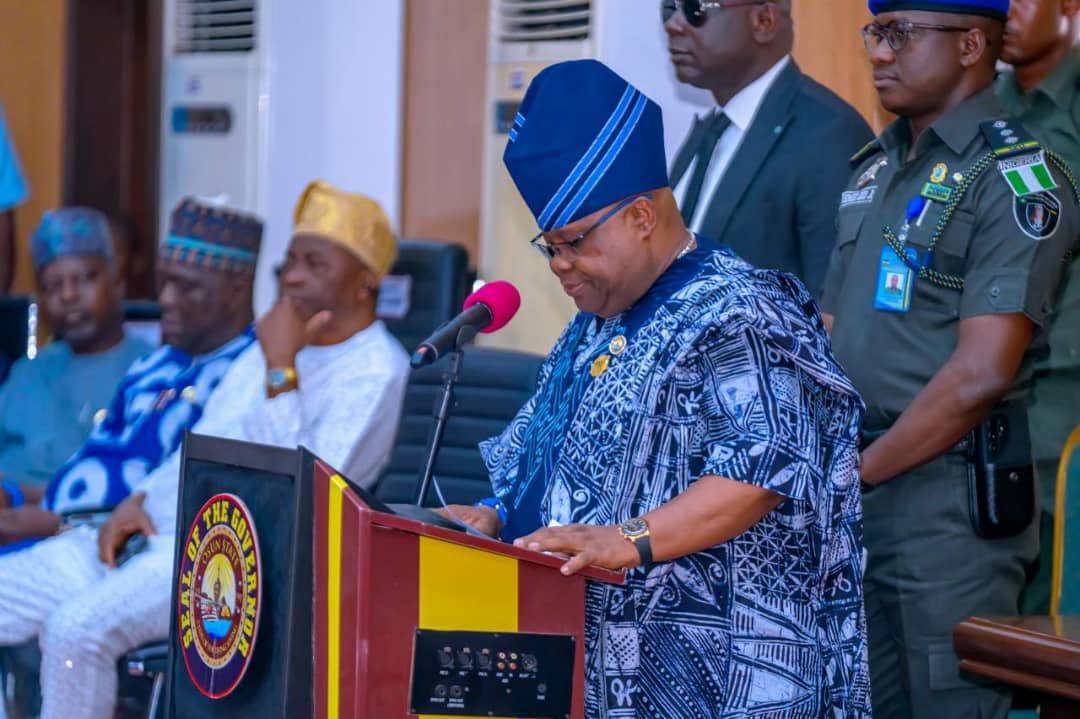
Earlier in the day, Adeleke presented a N927,370,584,800 budget proposal for the 2027 fiscal year to the Speaker and members of the Assembly. He was accompanied by his deputy, Prince Kola Adewusi, the Secretary to the State Government, Alhaji Teslim Igbalaye, the Chief of Staff, Alhaji Kazeem Akinleye, and other cabinet members. Traditional rulers, heads of parastatals, political leaders and government appointees witnessed the presentation.
The proposal is titled “Budget of Advanced Commitment and Expansion” and was drawn up in line with the reviewed Osun State Development Plan (2023–2050). The governor said it is designed to improve the ease of doing business, foster employment, enhance youth development, promote human capital growth and drive large-scale infrastructure. He said the 2027 fiscal year will focus on the administration’s Five-Point Agenda, which he described as covering infrastructural development, human capital development, revitalised agriculture, security of the state, and workers’ and pensioners’ welfare and job creation.
On revenue, he said the state expects N400,926,611,400 from the Federation Account Allocation Committee, N250,172,402,980 from independent revenue and N230,646,070,420 from development partners. On spending, N130,011,911,330 is earmarked for personnel costs, covering salaries, allowances, pensions and gratuities, while N238,051,506,680 is set aside for overheads. The largest share, N559,307,166,790, is proposed for capital projects across the state. Adeleke said the budget maintains a recurrent-to-capital ratio of 40 to 60%, with capital expenditure taking the larger portion. He also described the partnership between the executive and the legislature as one of the best in the state’s history and credited it for the progress recorded over the past four years.
In his welcome address, Speaker Adewale Egbedun commended the governor for sustaining government operations despite political, institutional and financial challenges, particularly the protracted local government allocation crisis. He congratulated Adeleke and his deputy on their victory in the August 15 governorship poll and noted that they would be sworn in for another four-year term within 48 hours. Egbedun assured the governor that the House would consider the 2027 Appropriation Bill promptly, but stressed that the task would be carried out with diligence and independence. He said lawmakers would examine the proposals thoroughly, guided by fiscal prudence, equity, transparency, developmental impact and value for public expenditure.
In a separate state broadcast, the governor thanked residents for their support during the election and said their sacrifices had helped sustain democracy in the state. He recalled the violence and hardship that marked the last governorship election, saying some residents were killed and others injured in the struggle to defend democracy, and paid tribute to the victims and their families. He said the events of the 2026 election had been documented in a book titled The 60 Days Siege and should serve as lessons for strengthening democratic values and institutions.
Adeleke said the best way to repay the people’s loyalty was to improve governance through more infrastructure, stronger social services and economic growth that creates jobs. “The principal goal of a government is the welfare of the citizenry,” he said, promising to “redouble” policy delivery to take Osun to greater heights. He added: “As your governor, I won’t let you down.”