



 By
By On Sunday, July 26, the quiet town of Okuku in Odo-Otin Local Government Area of Osun State became the latest flashpoint in a governorship race that has grown tenser by the week. At Oyinlola DC Primary School, Ward 2, where officials of the Independent National Electoral Commission had gathered to distribute Permanent Voter Cards to residents preparing for the August 15 poll, a group of armed men stormed the premises and threw the exercise into chaos. Witnesses put the number of attackers at around eight to ten, and accounts describe the assailants storming the venue without warning and firing gunshots into the air, sending residents and prospective voters fleeing for safety. By the time the dust settled, the attackers had escaped with some packs of Permanent Voter Cards, leaving behind a community shaken and a process meant to safeguard the credibility of the election visibly compromised.

The Osun State Police Command moved quickly to confirm the incident. Command spokesperson DSP Abiodun Ojelabi said the attackers fired several shots into the air, forcing electoral officials to flee before making off with the cards, while Commissioner of Police Ibrahim Gotan condemned the attack and ordered a comprehensive investigation aimed at identifying, arresting, and prosecuting those responsible. Beyond the official statement, though, the picture on the ground in Okuku carries far more texture and considerably more political weight than the police account alone suggests.
Odo-Otin has become one of the more combustible local government areas in the run-up to the election, with the Accord Party and the All Progressives Congress locked in a struggle for control that has spilled beyond campaign rhetoric into open confrontation. It is this contest, over who gets blamed, who gets protected, and whose account of the day survives into the public record, that the existing coverage has largely left unexamined.
What follows draws on interviews conducted directly in Okuku in the days after the attack, including first-hand accounts from eyewitnesses present at the school, a detailed corroborating account from the Accord Party faction, and comments from the Ward 2 APC chairman. Attempts to reach the Divisional Police Officer for an official account from the ground level were unsuccessful. However, these accounts begin to fill in what the wire reports and police statement left out, and they raise questions about the attack, its motive, and its aftermath that Okuku’s residents are still asking.
What did eyewitnesses see unfold at the scene?
Comrade Okunlola Tobi was at the collation centre in his capacity as the Accord Party agent supervising PVC collection for Baale, Ward 2, Okuku. He said the exercise had been proceeding normally, with residents arriving steadily to collect their cards, when the calm broke. He heard cries of “ole, ole, ole,” the Yoruba word for thief repeated in alarm, and moved toward one of the men he saw holding a stolen pack of cards. Before he could get close enough to act, gunfire rang out into the air, and he, along with everyone else within earshot, fled the premises.
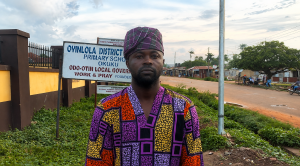
His account is corroborated in its broad strokes by every other source who spoke on the incident. What it adds, however, is a sense of how ordinary the moment felt right up until it wasn’t, a reminder that the men who carried out the attack did not announce themselves as a threat until it was too late for anyone to intervene.
How did unidentified men gain entry to a fenced, guarded collation centre?
Tobi said the men who entered the fenced school compound did not stand out as strangers with harmful intent. They walked in the way anyone else did that day, appearing to be residents who had simply come to collect their own PVCs. Four of them entered together, and he did not think to question them, since nothing in their appearance or manner set them apart from the queue of legitimate voters. He said he assumed, if he thought about it at all in the moment, that they might have been registered through other party members or through fellow Accord Party figures he did not personally know, and that this assumption was part of why nobody stopped them at the gate.
Our reporter also asked directly whether the men displayed any political affiliation, and he said they wore nothing, no insignia, no colours, no identifying marks of any party. Whatever else the attack was, it was not carried out by men advertising who sent them.
That anonymity matters because of what happened next. According to Tobi, the men did not simply grab cards and run. They took packs of PVCs while INEC officials were still in the process of verifying voters’ details, meaning the theft happened in full view of the commission’s own staff, in the middle of an active, supervised process, not in some unguarded corner of the compound.
Did the ward and local government leadership corroborate the same version of events?
Yes, in substance, though each brought a different vantage point. The Local Government Vice Chairman, Hon. Omoniyi Kayode Surajudeen, and the Ward 2 Councillor, Hon. Kolapo John Akinloye, both confirmed the incident when approached directly.
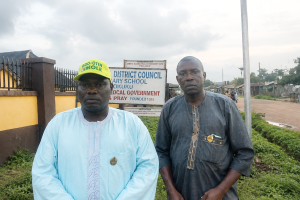
The Vice Chairman said he had personally been at the venue earlier that Sunday to observe the atmosphere and gauge turnout, and that everything appeared calm and orderly when he left. It was only after he had departed that the party representative stationed at the centre called to alert him that the attack had happened.
Pastor Ogundele Gabriel, the APC’s Ward 2 chairman, offered a broadly similar sequence but from the other side of the political divide and with far more personal proximity to the danger. He said he was at the venue himself, with a party leader and his child; together with their ward councillor were present as well that day. He was preparing to leave when he heard the same cries of alarm that Tobi described and said one of the attackers fired gunshots into the air, at which point everyone on the premises scattered.
Where the two sides diverge is not on whether the attack happened, but on what it means and who bears responsibility for it, a divergence that runs through nearly every other question this report raises.
What did the vice chairman do once he learned of the attack, and how did the authorities respond?
By his own account, the Vice Chairman acted immediately. As soon as he was informed, he called both the INEC Electoral Officer and the Divisional Police Officer in Okuku to report the development. He also said he supported the decision, taken in the attack’s immediate aftermath, to withdraw INEC officials from every PVC collation venue across Okuku that day, out of concern that other centres could be targeted next.
According to the Vice Chairman, the Okuku divisional police headquarters indicated, as of the Monday after the attack, that a report was still being compiled, and no PVC distribution resumed that day. No individual returned to the ground in any visible way until Tuesday, two days after the incident. He noted, however, that the DPO had visited the scene earlier to inspect it directly, even before that continued police presence resumed on Tuesday.
Separately, Accord Party leaders in the area said their canvassers were working to reassure voters that PVC collection would continue despite the disruption and were actively encouraging supporters to come out and re-register their intent to vote for the reelection of Governor Ademola Adeleke.
Why does the APC chairman allege the attack was staged to embarrass his party?
This is the most contested thread in the entire episode and the one least likely to appear in a police statement, as Pastor Gabriel laid out a chain of circumstantial detail that, in his telling, points toward the attack being deliberate rather. He said that upon returning to town after the incident, he heard allegations from residents that the vehicle used by the attackers had previously been seen parked at the residence of Rt. Hon. Egbedun, the Speaker of the State Assembly and a prominent figure aligned with the Accord Party. He was careful to note that he did not see the vehicle there himself and that what he has is a secondhand claim from others in the community, not a firsthand observation of his own.
He pointed as well to the timing and content of the Speaker’s public statement, issued shortly after the attack became known, framing it as a sign of the Accord Party’s political desperation. To Gabriel, releasing such a statement so quickly, before any investigation had concluded, suggested the incident may have been anticipated, or worse, arranged, specifically to be pinned on his party ahead of the release of a damaging narrative.
He also raised what he described as a pattern in attendance at the centre in the days surrounding the attack. Accord Party members, he said, turned out in visible numbers on the Saturday before the attack and again on the Tuesday when INEC resumed distribution, but were noticeably scarce at the venue on the Sunday the attack actually took place. To him, that absence on the one day violence occurred was not a coincidence but a sign that some among them may have had advance knowledge of what was coming.
None of these claims amount to proof, and none were independently verified by this reporter beyond what Gabriel himself asserted. They are presented here as his allegations, not as fact, precisely because the gap between what residents suspect and what can actually be confirmed is itself part of the story of how political violence gets processed and sometimes weaponized in a contest this close.
Was there already a dispute over fairness inside the PVC distribution process before the attack happened?
According to Gabriel, yes. He alleged that the INEC staff member originally assigned to distribute cards at the centre had been showing favouritism toward Accord Party-aligned residents, effectively tilting the process before the attack ever occurred. He said that once this was reported, the Electoral Officer responded by replacing that staff member with another official whom he described as fair to all parties involved.
Separately, he said complaints had reached him, in his capacity as ward chairman, alleging that individuals aligned with the Accord Party had been collecting the personal card details of young and newly registered voters, offering them money in exchange, and in some cases requiring them to take an oath involving water and red palm oil as a condition of the exchange. He said three people had come to him directly with such complaints. This allegation is serious and unverified beyond Gabriel’s account of what was reported to him; it is included here because it formed part of what he described as the tense backdrop against which the attack occurred, not as a confirmed practice.
Why couldn’t the Divisional Police Officer be reached, and what do we actually know about the police investigation?
Despite repeated efforts, the DPO of Okuku Division could not be reached directly for this report, a gap that mirrors the broader difficulty residents describe in getting authoritative, on-the-record answers about what is actually being done. What is known comes secondhand, through the accounts of the Vice Chairman and Gabriel. Both said the matter was formally reported to the Okuku divisional police headquarters and to the Odo-Otin Electoral Officer. Gabriel said police assured them the case was being actively worked on, and claimed officers already had a count of how many cards had gone missing broken down by unit level, though no public figure confirming that count has been released.
The Osun State Police Command’s own public statement, issued through DSP Ojelabi, stopped at confirming the broad outline of the attack and the Commissioner of Police’s order for an investigation. It offered no further detail on suspects, timelines, or the discrepancy between the ten or so attackers described by police and the slightly lower estimate of eight given by at least one witness on the ground.
How is INEC responding, and does the theft actually threaten the election?
Asked directly whether the attack could set back preparations for the August 15 poll, Oketola’s answer was unambiguous. INEC, he said, cannot be distracted. He backed that position with figures, citing 4,427 BVAS units configured for the election statewide, with a further 664 held in reserve as backups, alongside 97 Super Registration Area Centres and 105 Registration Area Centres already established across the state’s local government areas, all set to be activated the night before polling.
On the stolen PVCs specifically, Oketola argued the theft was ultimately of limited practical value to whoever carried it out. He explained that BVAS’s biometric verification system closes off any possibility of someone using a stolen card to vote in another person’s name, since the machine checks the voter’s fingerprint or facial data against the card, not the card alone. The era of the so-called ghost voter, he said, is over.
Read Also: INEC Extends PVC Collection at Registration Areas to July 31 in Osun
For residents whose cards were among those taken, he offered a specific reassurance that nobody already on the voters’ register would be barred from voting on account of the theft and that INEC would take whatever administrative steps were necessary to protect their right to cast a ballot on August 15. He closed his briefing with an appeal to security agencies, traditional and religious leaders, and political stakeholders across the state to work together, not only to keep the election free of violence, but also to give Osun residents enough confidence in the process actually to turn out and vote.
Final Note
Stripped of the competing political framing, the facts that can be said to be settled are that armed men entered a fenced, actively supervised PVC distribution centre in Okuku on a Sunday afternoon, without drawing suspicion at the gate, and left with voter cards and, according to INEC’s own account, after firing shots that scattered residents, officials, and party representatives from both major camps. Nobody who spoke for this report claims to have identified the attackers, and no arrests had been announced as of this writing.
Everything beyond that settled core splits along the fault line running through Odo-Otin’s politics. What remains unresolved, and what neither the police statement nor INEC’s national briefing has addressed, is the specific question raised independently by sources on both sides of the political divide, whether the attack was opportunistic criminal theft or something planned around foreknowledge of when the centre would be least protected by either party’s own supporters. Until the Osun Police Command speaks on the record, that question will remain exactly what it is for the residents of Ward 2 right now, an open one, sitting uneasily alongside a governorship election just over two weeks away.