

 By
By As the Kwara State Federal Road Safety Corps’ three-day special patrol, “Operation Kasolayo”, entered its final day on Wednesday, 22nd of July, 2026, commercial drivers and transport unions in Ilorin said they had neither been formally notified of the exercise nor encountered any of its patrol teams.
Drivers operating from interstate parks in Ilorin, including those on the Ibadan and Lagos routes such as Alubarika Decency and Dan Alikali motor parks on Geri Alimi and Odota axes, told our correspondent on Tuesday that they were unaware any special operation was underway and had not sighted any patrol team.
Mr Wasiu, one of the drivers who spoke in Yoruba, said that although he had not travelled the previous day, news of any patrol would have reached him all the same. “As drivers, we always inform ourselves about happenings on the road, and nobody mentioned it,” he said. He noted, however, that the transporters who own the vehicles maintain a synergy with the FRSC, whose officers are familiar with the park, and might have been informed directly.
Another driver, Mr Adeniyi Adepoju, said he travelled out of Ilorin and returned around evening the same day without seeing any patrol team on the road.
At Alubarika Decency Motors, an Ilorin-Lagos interstate park, the proprietor, Alhaji Ayuba Alubarika Decency, said none of his drivers had mentioned encountering the operation, “or they probably forgot to inform him,” he added, even as he applauded the government for its efforts at keeping lives and property safe.
The State Administrative Secretary of the Road Transport Employers’ Association of Nigeria (RTEAN), Alhaji Abdul Ganiyu Temitope, said the union had received no formal communication about the exercise.
“We are not aware of it,” he said, adding that he expected the Corps to “send a letter to us before the commencement of the programme.” Asked whether any member had reported a stop-and-search or delay since the operation began, he replied: “No. There’s nothing like that.”
He explained that the union keeps a register of its drivers and routinely passes official information to members through its meetings and daily activities.
During the course of his interaction with our correspondent, Mr Ganiyu called the Kwara FRSC Public Relations Officer, who confirmed that the campaign was ongoing.
The union scribe nonetheless welcomed the initiative, describing it as “a good programme that will save lives and property,” and urged RTEAN drivers to maintain speed limits in compliance.
“We Cover All the Routes”
Responding to the claims in an interview on Wednesday, the Sector Commander of FRSC RS 8.1, Kwara State, Kazeem Babatunde Kabir, said the Corps owed transport operators no special announcement because engagement with them is a daily routine. The Corps’ Sector Commander in Kwara State insisted the operation covered every route in the state.
“Public education concerning the union is something that is ongoing; it’s everyday operations. That’s what we call morning cry. We go to the park early in the morning to talk to the drivers before they even take off,” he said. “Probably what they are expecting is maybe we will come and tell them we want to do this or that. No. Our discussion with them is on a daily basis. It is not particular to this programme alone.”
On why drivers said they had not met any patrol team, the commander conceded the teams might not yet have reached some areas, but maintained that coverage was total.
“Probably the team has not gotten to that area, but we cover all the routes within the state. No route is exempted,” he said. “I’m sure they will see them probably today, or maybe they’ve been there yesterday, and they may not notice.”
“Only the Living Can Celebrate”
Kabir explained that Kasolayo, a Yoruba expression meaning “get to your destination safely”, is the local code name for a nationwide exercise running simultaneously across the FRSC’s 12 zonal commands. The zone covering Kwara, Ekiti and Kogi States flagged off its own leg on Monday, 20th of July 2026, under the zonal commanding officer, Assistant Commander A. O. Olaleye.
“As we normally say, only the living can celebrate,” the commander said. “We wish the travellers a safe journey to their destination.”
He said the patrols targeted “critical offences” capable of causing crashes, which included excessive speeding, overloading, dangerous driving, mixed loading and driver fatigue. He linked the focus to a crash at Okolowo two weeks earlier, in which he said 15 people died and 17 others were seriously injured.
“What we observed there was an issue of mixed loading, where they mixed passengers with loads such as luggage and animals, and then fatigue, because some of these drivers travel for a very long distance without taking a little rest,” he said.
Strategy and the Missing Numbers
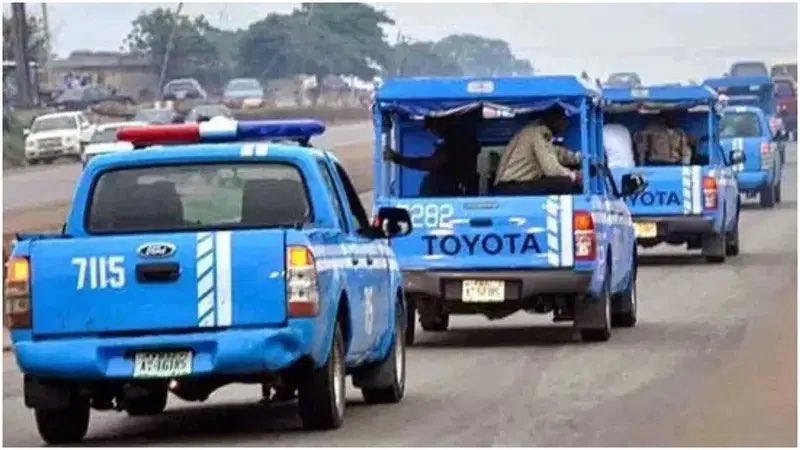
The commander said the operation ran full-day for all three days, using inter-command and joint patrols. Patrol teams were deliberately switched between commands; the Ilorin sector team deployed to the Unit Command’s territory and vice versa, while joint operations paired commands including Ilorin, Odo-Owa, Eruku, and Offa.
Asked for the operation’s results, however, he offered no figures. “I cannot give you the statistics of the arrests for now,” he said. He, though, rated the exercise as “very, very great,” citing a visit from the Tipper Association, whose members he said came to his office on Monday to commend the Corps for turning back one-way drivers at Okolowo.
On Extortion Claims and Bad-Road Checkpoints
Responding to motorists’ perception that highway stops amount to harassment or extortion, Kabir said officers stop vehicles only when an offence has been sighted. “It is not every vehicle that plies the road you stop. Before you stop a particular vehicle, you must have cited one offence or the other,” he said, adding that officers cannot stop every vehicle at once: “It is when you are done with a vehicle that you allow it to go before you can stop another one.”
On why patrol teams often position themselves at potholes and bad portions of road, he said the locations serve a dual purpose of alerting drivers that the stretch is bad, and providing safe points where vehicles naturally slow down.
“We don’t use guns, and we don’t block roads. You cannot see FRSC blocking a road because they want to make an arrest,” he said.
“Early to Bed, Early to Rise”
The commander dismissed suggestions that the unions were sidelined. “We work hand in hand with unions anytime, any day. It’s not as if they are left out,” he said.
His parting advice went to the motorists themselves: rest at intervals on long journeys, avoid mixing goods or animals with passengers, shun overloading, check vehicles before departure, and leave early.
“If you take off on time, you get to where you are going at a very good time,” he said.