

 By
By - Incident occurred August 24; publication follows three weeks of independent verification
- Osun Police say hoodlums ambushed a patrol and killed two civilians with a hijacked rifle. A widow, market witnesses and the man officers say they were trying to rescue describe a different, and in places conflicting, version of events.
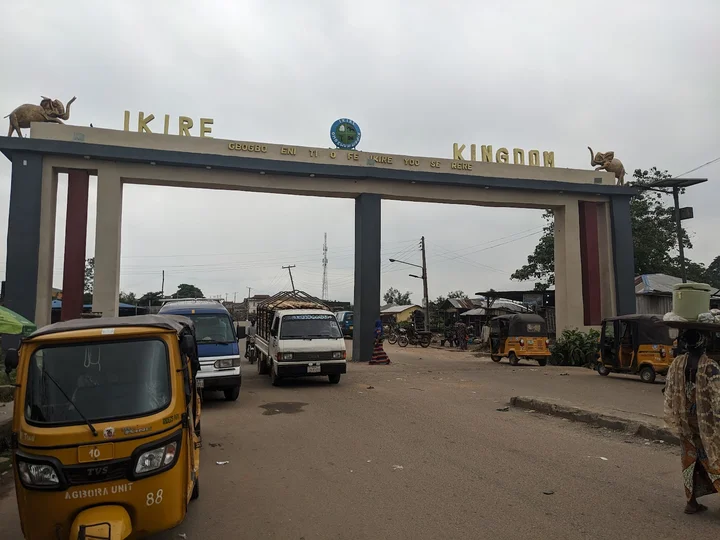
Nureni Sobowale, 49, was travelling home to Bayelsa State on Monday, August 24, with his wife in a Toyota Sequoia they had boarded in Ibadan after attending an event there. He never completed the journey. As the vehicle passed through the Naira and Kobo motor park area in Ikire, a stray bullet struck and killed him inside the moving vehicle. Saheed Akinrole, 43, died in the same shooting.
This report, though the incident occurred on August 24, is published three weeks later because AfrikTimes chose to independently verify each account gathered, from police, eyewitnesses, the victim’s family and the man at the centre of the police’s version of events, before this detailed report.
Sobowale’s widow told AfrikTimes she was seated beside her husband in the vehicle when he was shot, and that the bullet that killed him came from the police, not from the hoodlums the Osun State Police Command says ambushed officers and hijacked a rifle that afternoon. “I cried for Nigerians’ help,” she said, describing the moment. The couple leaves behind five children.
Her account is one of several gathered by AfrikTimes over the past three weeks that contradict the Command’s official version of what happened in parts, and that complicate it, in other parts, in ways that resist a simple resolution. AfrikTimes also found out that this event had nothing to do with NURTW members, as against the initial account given to us by some residents.
The Official Account
In a written statement (Ref: AZ: 5650/OSS/PPRD/VOL.T1/247) issued the day of the shooting, the Osun State Police Command said officers, led by the Divisional Police Officer (DPO), were responding to a distress call about the alleged abduction of a man identified only as Sunkanmi when their patrol vehicle was ambushed by unidentified hoodlums suspected to be political thugs. The assailants, police said, opened fire on the vehicle, snatched an AK-47 service rifle, and used it to fire indiscriminately, killing Sobowale and Akinrole. Two officers were said to have been seriously injured and referred to the University College Hospital (UCH), Ibadan, after initial treatment locally. The patrol vehicle was later recovered abandoned, its windscreen destroyed, and nine expended shells were said to have been collected from the scene for forensic analysis.
The Command’s Public Relations Officer, DSP Abiodun Ojelabi, maintained that version in a series of exchanges with AfrikTimes by phone, WhatsApp, and in person. “Police wouldn’t just shoot,” he said, when asked about the eyewitness allegations described below. It was a general defence of police conduct that stopped short of directly addressing the specific claim that the DPO fired the fatal shots. Ojelabi confirmed four suspects have been arrested, though no charges have been filed and no court date set. He also rejected any suggestion that the seized rifle belonged to the DPO personally, saying only that rifles had been seized in the operation.
A Different Story From the Ground
Multiple eyewitnesses at the motor park, including a relative of one of the deceased, independently told AfrikTimes a different story. They said there was no attack, no confrontation and no hoodlums at the scene when the shooting happened, and that they saw the DPO himself fire the shots that killed the two men.
Sobowale’s widow’s account adds a second, independent voice attributing the fatal gunfire to police rather than to hoodlums, though her vantage point differs from that of the motor park eyewitnesses. She and her husband were passing through inside a moving vehicle, not standing at the scene, and she described the shot that killed him as a stray round rather than a direct, targeted shot. She named the DPO specifically.
A member of Sobowale’s family told AfrikTimes he was the family’s breadwinner and ran a private business in Bayelsa, where he lived. The family said he was not from Ikire, and that their roots are in Abeokuta, Ogun State, and that he held no political office and belonged to no labour or transport union. By every account gathered, he was a traveller passing through, not a man with any apparent stake in local politics. AfrikTimes has not yet been able to gather comparable background on Akinrole, the second victim.
The Man at the Centre of it
The distress call police say sent them to the park that afternoon concerned a man identified as Sunkanmi, also known locally as Biodun Peter Lasunkanmi, and referred to by his employer as “Akowe Elepo.” AfrikTimes tracked him down and found visible wounds consistent with a physical assault.
Sunkanmi said he was going about his business in the market that day when four motorcycles pulled up, carrying twelve men in all. They told him they had come to “bring him” on the orders of a man he knew only as “Ayewo.” When he refused, he said, they drew machetes and attacked him. Market men and women intervened, but his attackers insisted, according to him. He also confirmed to AfrikTimes that the said attackers seized his phones on the spot.
The group returned, he said, and dragged him to the Naira and Kobo garage, where Ayewo was waiting and ordered him to kneel. There, Sunkanmi said, his attackers, all wearing caps bearing the Accord Party’s insignia, demanded to know why he worked for the All Progressives Congress instead. “I told them I was just a voter,” he said, “not a party man.”
It was then, he said, that he heard a police siren. In his account, the group ambushed the arriving officers before they could even step out of their vehicle and opened fire on them. This was the same weapon-hijacking moment central to the police’s official account. Sunkanmi said he used the chaos to grab back his motorcycle and flee, chased by some of the group while others turned to face the police. He said he learned only afterwards that two people had been killed and that he could not say who fired the shots.
Read carefully, Sunkanmi’s account does not have to contradict the motor park eyewitnesses. He confirms that an armed confrontation and a weapon hijacking took place, aligning, on that narrow point, with the police version. But by his own telling, he had already fled by the time the fatal shots were fired and never claims to have seen who fired them. His testimony and the eyewitnesses’ testimony may simply describe different moments of the same fast-moving incident, rather than two irreconcilable accounts of the same one.
‘I Was Confused About What To Do’
Alhaja Belau Elepo, the market figure who employs Sunkanmi as the group’s secretary and who first raised the alarm that day, gave AfrikTimes her own account of the hours after the attack began. She said she was alerted from the market that her rider was under attack and was, in her words, “confused about what to do,” before calling the Palace and then the police.
The Palace responded by sending a chief to the scene, she said. She could not say whether the attack was politically motivated, and noted that Sunkanmi was not a member of the National Union of Road Transport Workers. What she heard about the confrontation with police, she was careful to say, was secondhand. Word first circulated that police had opened fire, and later that “area boys” had attacked the officers. “I was not there,” she said. “That was what I heard.”
She also named a police officer she said was shot by the attackers and remains under treatment at UCH Ibadan, identifying him as “Officer Sunday,” and saying only one officer, to her knowledge, was hurt. That name has also surfaced independently among residents and bike-taxi operators interviewed separately by AfrikTimes around Obada Market, though it has not been confirmed by police or by the hospital, which maintains that two officers were injured.
Alhaja Elepo said she was summoned to give a statement to the Area Commander on the day of the attack but could not travel because her rider, the victim of the assault, was unavailable to accompany her. Officers instead came to her house, she said, where she gave a recorded statement.
What Could Not Be Confirmed
AfrikTimes visited UCH Ibadan in person to verify the claim that an injured officer was admitted there. Hospital staff said they could not confirm knowledge of the specific individual described, and the admissions register covering the relevant period could not be located; staff said it had been replaced by a newer register beginning September 14. No post-mortem examination has been conducted on either victim, and one of the two has since been buried, which may foreclose the possibility of an autopsy for him. The seized rifle, police say, has since been returned through the Palace, though the circumstances of that return, including who initiated it and when, remain unexplained.
No forensic evidence, whether ballistics or post-mortem findings, has yet confirmed either version of who fired the shots that killed Sobowale and Akinrole. In its absence, this remains a disputed allegation, not an established fact, on both sides.
Analysis: What the Evidence Most Likely Shows
A number of the facts gathered by AfrikTimes point in the same direction, and are worth weighing rather than simply set side by side.
Several independent threads support part of the police account. Random interviews with residents and okada riders, Alhaja Elepo’s account, and Sunkanmi’s own testimony all confirm that a real, armed group abducted Sunkanmi and later clashed with arriving police. Sunkanmi, who has no evident reason to protect the police, describes his attackers ambushing officers before they could leave their vehicle and seizing a police rifle in the process. Nine spent shells, a damaged patrol vehicle and two injured officers are consistent with an actual exchange of gunfire rather than an invented cover story.
Police maintain that although the rifle used in the killings was their own, it was in the hands of the hoodlums, not their officers, when the fatal shots were fired. That specific claim, that the gun was theirs but the trigger was pulled by the hijackers, is the part of the official account this report finds least supported by the evidence gathered so far.
Multiple unconnected motor park eyewitnesses did not simply report crossfire. They said they watched the DPO himself fire the shots. Sobowale’s widow, a source with no connection to those eyewitnesses, separately attributed the fatal round to police rather than to hoodlums. Two independent sources converging on police gunfire is meaningful corroboration, and no independent civilian witness has yet come forward to support the specific claim that the hijackers were the ones firing when the two men died.
The PPRO’s response is also worth weighing carefully. He did directly deny that the DPO fired the fatal shots, maintaining instead that the hijackers fired indiscriminately with the seized rifle. That denial exists, and this report treats it as such rather than as an evasion. But a denial is not evidence, and no ballistics test or ammunition trace has been produced to support it. The handling of the rifle compounds the uncertainty. The single weapon most likely to prove or disprove the hijacking claim through ballistics was returned to police, rather than preserved for forensic testing, an irregular step for the one piece of evidence that could settle the matter either way. No post-mortem has been pursued with urgency either, and one victim has already been buried.
The balance of independent eyewitness testimony, weighed against a police denial that has not yet been backed by forensic evidence, and the unresolved chain of custody of the one weapon that could prove the point, means the account given by eyewitnesses and Sobowale’s widow currently carries more corroboration than the account given by police. That is not the same as proof. It is a comparison of two accounts, one supported by multiple independent, unconnected sources, and one supported by the Command’s own denial and the arrests it has made. The likeliest reading, on the evidence gathered so far, is that police gunfire, quite possibly the DPO’s, killed Sobowale and Akinrole during a real and violent confrontation that Sunkanmi’s own account confirms did involve an armed group and a hijacked police weapon. This is AfrikTimes’ editorial judgment based on the balance of evidence gathered, not a proven fact. No ballistics report or post-mortem yet exists to confirm it, and none of the accounts in this report, including the PPRO’s denial, should be read as more than that pending such confirmation.
What This Report Does Not Say
This report does not name the DPO, and does not assert as fact that he, or any specific officer, fired the fatal shots. AfrikTimes is aware of a separate, unverified claim linking the arrested suspects to a sitting Senator, including an alleged voice recording; that claim could not be independently corroborated and has been excluded from this report. The political element reported here is limited strictly to what Sunkanmi says happened to him personally, the caps, and the question about his party allegiance, and should not be read as evidence of any wider political conspiracy.
Four suspects remain in custody. No charges have been filed. No post-mortem has been done. And three weeks on, Osun State still does not have a proven account of who killed Nureni Sobowale and Saheed Akinrole, though the weight of the evidence gathered by AfrikTimes points more toward police gunfire than toward the hijackers police have blamed.