


 By
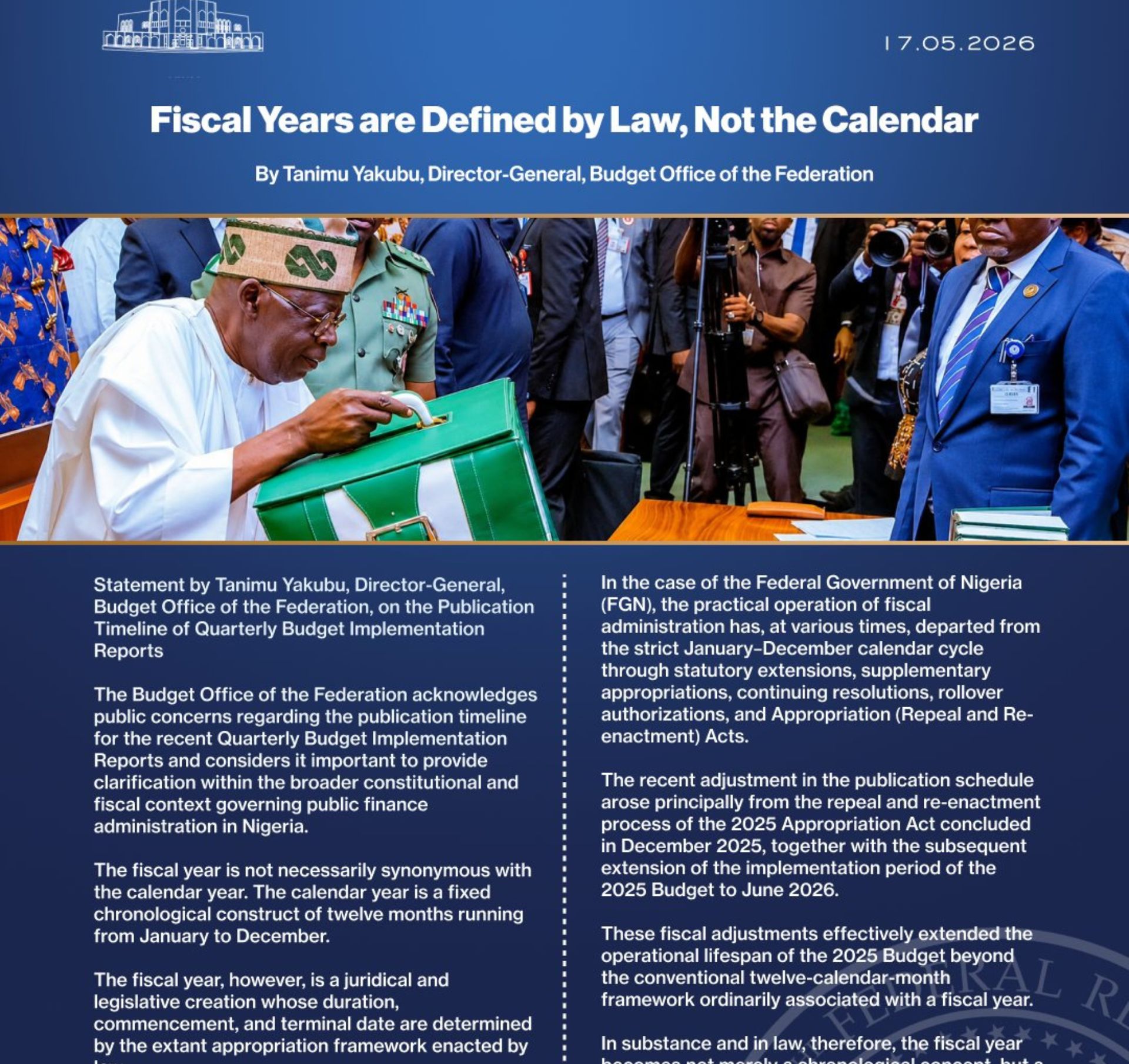
By The Presidency has clarified that Nigeria’s fiscal year is determined by law and not strictly by the January to December calendar cycle, following public concerns over delays in the release of Quarterly Budget Implementation Reports.
In a statement published by the Office of the Presidency and signed by the Director-General of the Budget Office of the Federation, Tanimu Yakubu, the Federal Government explained that fiscal operations can legally extend beyond a conventional twelve month calendar period when backed by legislative authority.
Yakubu stated that the fiscal year should not be confused with the normal calendar year. According to him, the fiscal framework of government is guided primarily by legislation and appropriation laws enacted by the National Assembly.
“The fiscal year, however, is a juridical and legislative creation whose duration, commencement, and terminal date are determined by the extant appropriation framework enacted by law,” Yakubu explained.
The Presidency linked the recent delay in publishing Quarterly Budget Implementation Reports to the repeal and re-enactment of the 2025 Appropriation Act, which was concluded in December 2025. It also referenced the subsequent extension of the implementation period for the 2025 budget to June 2026.
The statement noted that the extension effectively prolonged the operational life of the 2025 budget beyond the traditional January to December cycle usually associated with fiscal years.
According to the Budget Office, the adjustment became necessary to allow extensive reconciliation processes involving revenue reviews, expenditure alignment, debt updates, financing records, and inter-agency fiscal coordination before the reports could be finalized for publication.
The government maintained that the practice is not unusual internationally, citing countries such as the United States and India where fiscal years do not align with the regular calendar year.
The statement also referenced Sections 80 and 81 of the 1999 Constitution, arguing that withdrawals from the Consolidated Revenue Fund only require authorization through duly enacted legislation.
Yakubu further defended the legality of extending budget implementation periods, insisting that such measures do not violate constitutional principles.
“Such extensions did not create constitutional anomalies; rather, they reaffirmed the principle that the fiscal year derives its operative life from legislative authorization and not from the immutable chronology of the Gregorian calendar,” he stated.
The Presidency added that the outstanding Quarterly Budget Implementation Reports would be released in phases over the coming weeks.
It also disclosed that the Budget Office is strengthening digital reporting systems, improving institutional coordination, and enhancing data harmonization processes to ensure more transparent and timely fiscal reporting.